Overweight dog: how to help it lose weight (2026)
If you can't feel your dog's ribs, it's carrying extra kilos. How to check, what to rule out with your vet and a plan so it loses weight at a safe rate.
In this article
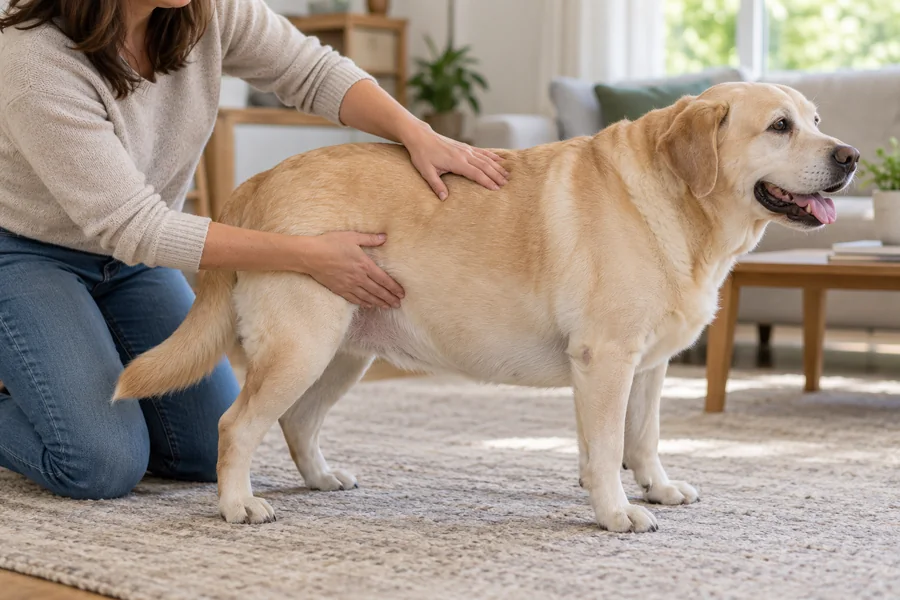
An overweight dog is recognised by its ribs more than by the scale: if you can’t feel them when you run your hand over them with gentle pressure, or you can’t see a waist from above, it’s carrying extra weight. Losing it is possible with a simple plan (a ration calculated on its target weight, weighed food, counted treats and weigh-ins every two weeks), and it usually fails for the same reason: it isn’t followed. Your vet sets the exact ration; here is how to check and what the veterinary sources say.
How to know if you have an overweight dog
The WSAVA body condition scale is the one vets use and runs from 1 to 9: 4 and 5 are the ideal weight, and above that there is excess. You can check in a minute, with your hands and your eyes:
| Score | What you notice |
|---|---|
| 4-5 (ideal) | Ribs easy to feel without excess fat; waist visible from above; abdomen tucked up when seen from the side |
| 6-7 (overweight) | Ribs can be felt under a growing layer of fat; waist barely visible; fat over the back and at the base of the tail |
| 8-9 (severely overweight) | Ribs barely or not at all palpable; no waist or tucked abdomen; bulging belly |
The MSD Veterinary Manual also measures it as a percentage: overweight is 10-20% above ideal weight and obese, more than 20%. If your dog fits the second or third row, the next step is the vet.
Why an overweight dog lives a shorter life
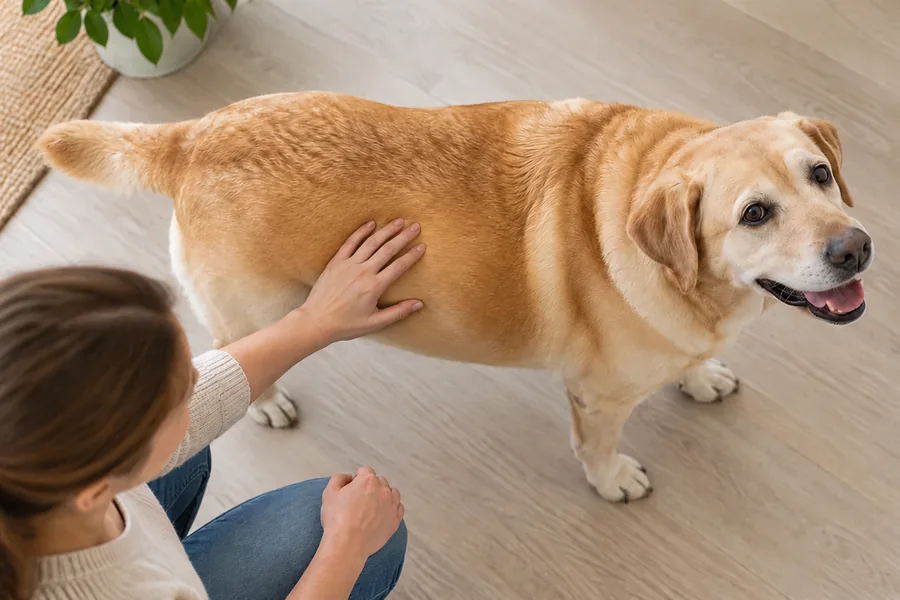
Extra kilos aren’t a cosmetic problem. In the best-known study, 48 Labradors were paired within each litter and one of each pair ate 25% less for its whole life: median lifespan was 13.0 years against 11.2, and they started needing treatment for a chronic disease at 12.0 years against 9.9 (Kealy et al., JAVMA 2002).
It was a Purina study, with a single breed and very controlled dogs, but it fits what Veterinary Focus describes: obesity is the most common disorder in dogs and cats and is linked to several diseases and a shorter life.
Before putting it on a diet: rule out a medical cause
The most common cause is eating more than is burned, but not the only one. The MSD Veterinary Manual describes how hypothyroidism slows the metabolism and can cause weight gain without a bigger appetite.
And if the dog eats more than usual, drinks a lot, pants and has a pendulous belly, the same manual links it to Cushing’s syndrome, an excess of cortisol. That’s why the first step is a vet check, with tests if needed, before touching the food: if there’s an illness behind it, diet alone won’t fix it.
How to help an obese dog lose weight in 5 steps
It’s the plan the studies follow and the one your vet will give you:
- Set the target weight and the ration with your vet. The ration is calculated on the weight you want to reach, not on the current one, as in the largest international study, with 926 dogs.
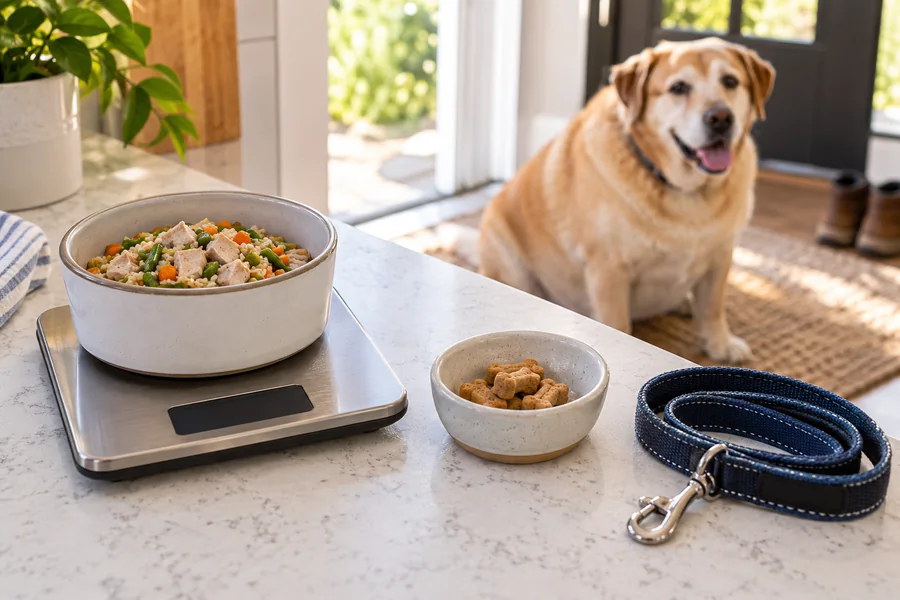
- Weigh the food and split it into several meals. With scales, not by eye. The MSD Manual advises dividing the daily ration into several meals instead of one big one.
- Count treats within the ration. They shouldn’t exceed 10% of daily energy: it’s the limit that, according to this 2025 study, WSAVA and AAHA recommend. In our snacks guide you’ll find which to give.
- Increase the walks little by little. Exercise helps, but with an obese dog it’s best to increase it gradually and with your vet’s go-ahead.
- Weigh it every two weeks and adjust. That’s what the MSD Manual advises. If it isn’t losing at the expected rate, the vet adjusts the ration: in a study of 73 obese dogs it was raised or lowered by 10% at each check-up.
A sensible rate is around 1% of body weight a week, about 200 g for a 20 kg dog. In the largest international study the average loss was 0.9% a week: the average dog lost 11.4% of its weight in three months and only 65 of 926 (7%) reached their target weight in that time. It takes months, not weeks.
A common brake is not following the plan. In the study of 73 obese dogs, 64% lost less than 1% a week, and in almost half of those cases (21 of 47) the owners weren’t following the food or exercise plan. Its authors conclude that non-compliance is a great challenge in canine obesity and may matter more than other factors.
If you feed natural food, calculate by energy
Cooked food and BARF contain a lot of water: Rovinfood’s chicken menu, for example, declares 71.7% moisture and 1,307 kcal/kg. That’s why grams mislead: what counts is each brand’s calories and the ration your vet or the brand’s calculator works out for you.
And don’t cut a maintenance menu back on your own. According to the MSD Manual, restricting a maintenance food can leave the dog short of nutrients, and that’s what menus formulated for weight loss are for.
Among natural food brands, Guau&Cat has a Menú control de peso (weight-control menu), cooked and BARF, designed for adults that need to lose weight and made with low-calorie ingredients. The 5 kg cooked box cost €24.24 on 15 October 2026 (€4.85/kg).
The trade-off: it needs a freezer, has a 5 kg minimum order and its product page shows no calories or analysis: ask the brand for them before calculating the ration. More on the brand in our Guau&Cat review.
Natuka groups lean-protein menus in its “Control de peso” collection, but they’re menus it also sells as standard, not a different formula. If you want to see more brands, there’s our cooked food comparison.
When to see the vet
Before you start, always. And go back if it doesn’t lose weight after several weigh-ins following the plan, if limping, tiredness or panting on walks appear, if it drinks or eats much more than usual, or if it has another illness (diabetes, heart, kidney): in those cases the diet is set by the vet, not a guide.
If you need to work out how much natural food to give, in grams, by weight, use our weight table; and if the one who’s running tight is your cat, we have the neutered cat guide. And the rule that always applies: the best plan is the one you keep up every day, even when it looks at you with hungry eyes.
Frequently asked questions
How do you help an overweight dog lose weight?
With a plan set by your vet: target weight, a ration calculated on it, weighed food, treats within the ration and weigh-ins every two weeks. A sensible rate is around 1% of body weight a week.
How long does an obese dog take to lose weight?
Months. In the largest international study (926 overweight dogs), the average loss was 11.4% in three months and only 7% reached their target weight in that time.
Can I cut its ration myself?
It’s not advisable. According to the MSD Manual, restricting a maintenance food can leave the dog short of nutrients. The vet adjusts the amount or recommends a menu formulated for weight loss.
How many treats can an overweight dog have?
Less than 10% of its daily energy, counted within the ration, not as an extra.
Does natural food help a dog lose weight?
Not on its own: what makes a dog lose weight is eating less energy than it burns. Natural food contains a lot of water, so you need to calculate by calories, and there are menus formulated for weight control.
Why is my dog putting on weight when it eats the same?
Because it burns less energy (with age, after neutering or with less exercise) or because of an illness such as hypothyroidism. If it puts on weight without eating more, ask for a vet check.
This guide is informational and does not replace a consultation with your vet.
Keep reading
 Health & wellbeing
What bones can dogs eat (and which ones are dangerous)
Cooked bones, never. Raw ones, with conditions. Here's the full picture, without the vested interests of whoever is selling kibble or bones.
 Health & wellbeing
Bland diet for dogs: what to feed, how much and for how long
The chicken-and-rice routine done properly: proportions, real amounts, how long to keep it going, and the signs your dog needs a vet, not a diet.
 Health & wellbeing
Neutered cat: how much and what to feed it so it doesn't put on weight
Neutering isn't just surgery: it changes your cat's metabolism for life. We explain how much to feed it and how to keep an eye on its weight without obsessing over it.