Bland diet for dogs: what to feed, how much and for how long
The chicken-and-rice routine done properly: proportions, real amounts, how long to keep it going, and the signs your dog needs a vet, not a diet.
In this article
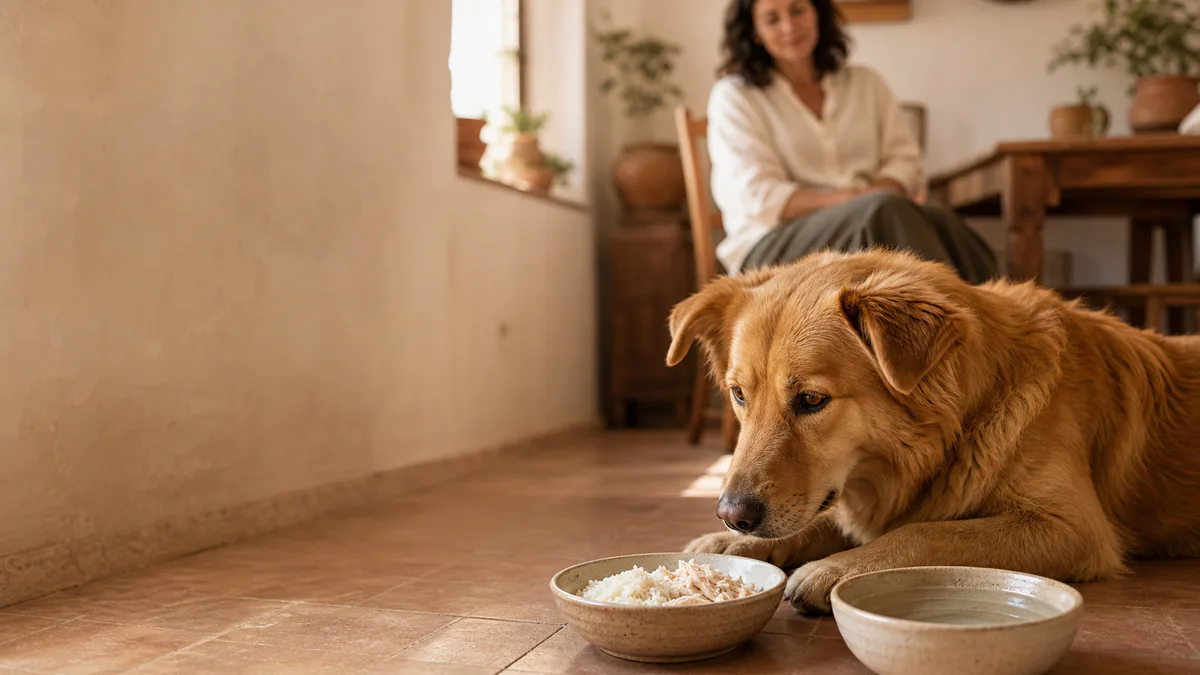
A bland diet for dogs is a temporary regime of highly digestible, low-fat foods — typically cooked lean protein and a gentle carbohydrate, in roughly a 70 % to 30 % ratio — split across 3 or 4 small meals a day and maintained for 2 to 3 days. It’s for mild digestive episodes, and it does not replace a vet when warning signs are present. On day one, offer around half the usual volume and build up progressively as tolerated.
One warning before we start, because it’s the most common confusion: the human “bland diet” is not a reference point for a dog. The human version includes dairy, bread, apple purée and mashes that disagree with many dogs or make the diarrhoea worse outright. Don’t copy the one from home.
What it is (and isn’t)
It isn’t a therapeutic diet or a treatment. It’s a way of giving the digestive system easy work while it recovers: low fat, low insoluble fibre, no seasoning, no lactose, and nutrients that absorb without effort.
And there’s an uncomfortable thing to say from the outset: it is not a complete diet. Chicken and rice, sustained over time, causes real deficiencies in calcium, essential fatty acids, vitamins and trace elements. It’s a three-day tool, not a way to feed a dog.
Foods to use
Cooked boiled or steamed, without salt, oil or any seasoning.
| Food | Why it works |
|---|---|
| Chicken or turkey without skin or bone | Lean, highly digestible protein, well accepted |
| Hake or another white fish | Equally digestible and even lower in fat |
| Rabbit | A good option if the dog has already had a lot of chicken |
| Boiled egg | High-quality protein; whole or white only |
| Very well-cooked white rice | Easily absorbed starch; cook it longer than usual with plenty of water |
| Boiled potato or sweet potato, peeled | Alternative to rice, useful if the dog doesn’t tolerate it |
| Cooked pumpkin or carrot | In small amounts: soluble fibre that firms up the stools |
The reference proportion is roughly 70 % protein to 30 % carbohydrate. There’s no need for laboratory precision: two-thirds chicken to one-third rice is guidance enough.
A practical tip: keep a little of the chicken cooking water (unsalted) and mix it in. It adds hydration and makes the meal more appealing, which is no small thing in a dog with an upset stomach.
Foods to avoid
- Milk, cheese and dairy generally. Many adult dogs digest lactose poorly and it can worsen diarrhoea. Yoghurt is often recommended for its probiotics, but that isn’t a universal recommendation: check first.
- Fat: oil, butter, chicken skin, fatty meats. Fat is precisely what’s tolerated worst and a known trigger for pancreatitis.
- Salt and seasonings.
- Onion and garlic: toxic to dogs, in any quantity and any form, including ready-made stocks.
- Bones, cooked ones especially.
- Spicy food, cured meats, table scraps.
- Wholegrain cereals and raw fibrous vegetables: here insoluble fibre doesn’t help, it irritates.
Amounts: how much to actually give
This is the part that’s almost never explained, and the one that causes the most doubt.
What matters isn’t the total amount but the splitting. An irritated stomach tolerates four small portions far better than one large one, even if they add up to the same.
A reasonable progression for a healthy adult dog:
- Day 1: around half the volume they normally eat, split into 3 or 4 small meals.
- Day 2: if there’s been no further vomiting and the stools are improving, move up to around three quarters of the usual volume, still split.
- Day 3: normal volume, split across 3 meals.
And water always available. In a digestive episode, dehydration is the real risk, more than missing food. If your dog can’t even keep water down, that isn’t a bland-diet situation: that’s a vet, now.
The exact amount depends on weight, age and the underlying cause, and your vet will judge it better than any generic table.
Should they fast first?
The thinking here has changed and it’s worth knowing, because a lot of outdated advice is still circulating.
Prolonged fasting is no longer routinely recommended. For years the advice was “24 hours without food”; today the preference is to reintroduce food early and in small amounts, because the cells lining the gut are nourished largely by what passes through it and recover better when fed than when rested.
A short fast of a few hours after vomiting may make sense, to let the stomach settle before offering anything. What isn’t appropriate is leaving a dog a whole day without food as a matter of course. And you never fast a puppy, a toy-breed dog, a geriatric dog or one with an existing condition: the risk of hypoglycaemia is real.
How to prepare it, step by step
- Boil the chicken (or fish) without skin, bone, salt or anything else. Shred it well.
- Cook white rice for longer than usual with plenty of water, until very soft.
- Mix in roughly 70/30 proportions, protein to carbohydrate.
- Let it cool to lukewarm. Neither hot nor straight from the fridge: warm food is accepted and digested better.
- Split across 3 or 4 meals through the day.
- Store leftovers in the fridge for a maximum of 2 days, and serve each portion warmed.
How long it lasts and how to switch back
Two to three days, rarely more than five. If the stools have normalised by day 2 or 3, start the transition back:
- Transition days 1-2: 75 % bland diet + 25 % their usual food.
- Days 3-4: half and half.
- Days 5-6: 25 % bland diet + 75 % their usual food.
- Then their normal diet.
If diarrhoea returns at any step, go back to the previous one and seek advice.
When a bland diet is not the answer
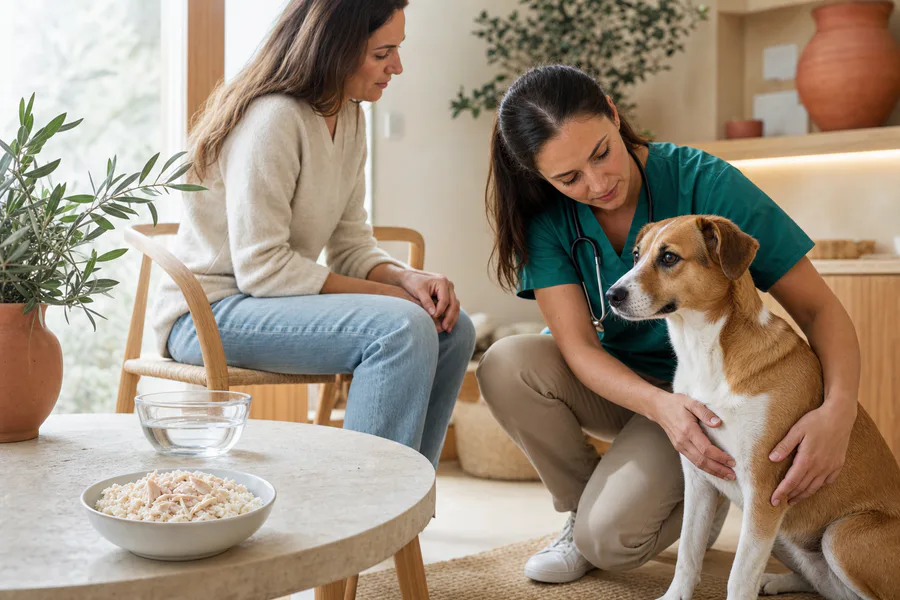
This is the most important section of the article, and the hardest to find elsewhere. A bland diet is for a mild, one-off episode in a dog that is otherwise fine. It doesn’t work — and it delays diagnosis — in these situations:
- Blood in the stools or vomit, or black, tarry stools.
- The dog is lethargic, apathetic or weak, beyond just being a bit off.
- Repeated vomiting or an inability to keep water down.
- Abdominal pain: hunched posture, yelping when you touch the belly, reluctance to move.
- Retching without bringing anything up, with a swollen abdomen: in deep-chested dogs this can be gastric dilatation-volvulus, a life-threatening emergency that cannot wait.
- Fever, pale gums or signs of dehydration.
- Puppies, geriatric dogs or dogs with existing conditions: the margin here is far smaller.
- Suspicion they’ve eaten something they shouldn’t: a foreign body, a toxin, a plant, human medication.
- The episode lasts more than 48 hours or recurs every few weeks. Recurrent diarrhoea isn’t a bland-diet problem: it’s something to investigate.
In any of these cases, see a vet, and don’t wait to see how it develops. A bland diet cures nothing: it simply eases recovery when the problem is already resolving on its own.
And afterwards?
If your dog has digestive episodes fairly regularly and your vet has already ruled out medical causes, the problem may lie in the everyday diet: food that’s too fatty, a change made too fast, or an ingredient that doesn’t agree with them. You’ll find the most common causes in our guides on why your dog is vomiting and diarrhoea in dogs.
And if you’re considering changing their food, always do it gradually, over 7-10 days: abrupt changes are, on their own, one of the most common causes of diarrhoea. The step-by-step is in how to switch from kibble to natural food, and the options are compared in choosing natural dog food.
This guide is informational and does not replace a consultation with your vet.
Keep reading
 Health & wellbeing
 Overweight dog: how to help it lose weight (2026)
If you can't feel your dog's ribs, it's carrying extra kilos. How to check, what to rule out with your vet and a plan so it loses weight at a safe rate.
 Health & wellbeing
 What bones can dogs eat (and which ones are dangerous)
Cooked bones, never. Raw ones, with conditions. Here's the full picture, without the vested interests of whoever is selling kibble or bones.
 Health & wellbeing
 Neutered cat: how much and what to feed it so it doesn't put on weight
Neutering isn't just surgery: it changes your cat's metabolism for life. We explain how much to feed it and how to keep an eye on its weight without obsessing over it.