What bones can dogs eat (and which ones are dangerous)
Cooked bones, never. Raw ones, with conditions. Here's the full picture, without the vested interests of whoever is selling kibble or bones.
In this article
A dog should only eat raw bones, never cooked, always under supervision and chosen to suit their size and chewing style. Cooked bone is never given: cooking makes it brittle and it splinters into sharp fragments that can perforate the digestive tract. And although raw is the only defensible option, it isn’t harmless either: there are real risks of dental fracture, choking and obstruction worth knowing about before you give the first one.
On this topic you’ll find two opposing narratives, and both come from someone selling something. Kibble manufacturers tend to recommend no bones, ever. Raw and BARF brands explain which ones to give and how. Both positions have a point, and both have a commercial interest behind them. We sell neither kibble nor bones, so we’ll set out the full picture and let you decide.
The rule with no exceptions: never cooked
Can I give my dog cooked bones? No. Never.
Cooking strips the bone of water and collagen, the matrix that gives it elasticity. What’s left is a dry, brittle material that, instead of yielding when bitten, breaks into sharp splinters. Those splinters can:
- Cut the gums, tongue or palate.
- Lodge in the oesophagus when swallowed.
- Perforate the stomach or intestine, causing peritonitis — a surgical emergency with a risk to life.
- Form a compact plug in the colon and cause severe, painful constipation that’s difficult to resolve.
This applies to all cooked bones, without distinction: stew bones, roast bones, ham bones, rotisserie chicken carcasses, barbecue ribs and the leftovers of any dish. Being large doesn’t make it safe; being beef doesn’t either.
And let’s dismantle a dangerous myth, because it circulates widely: no, stomach acid does not reliably dissolve bones. It can partly soften small raw bone, but it doesn’t make cooked-bone splinters disappear. A good share of the obstructions seen in practice happen because someone assumed it would dissolve on its own.
Which bones a dog can eat
Only raw, and within raw there are two categories worth not confusing:
Edible meaty bones
Soft, chewable and digestible. Given as part of a meal, not as entertainment.
- Chicken or turkey necks
- Chicken wings and carcasses (for dogs that chew, not ones that gulp)
- Rabbit ribs
These suit dogs that genuinely grind their food. In a dog that swallows things whole, they’re a choking risk.
Recreational bones
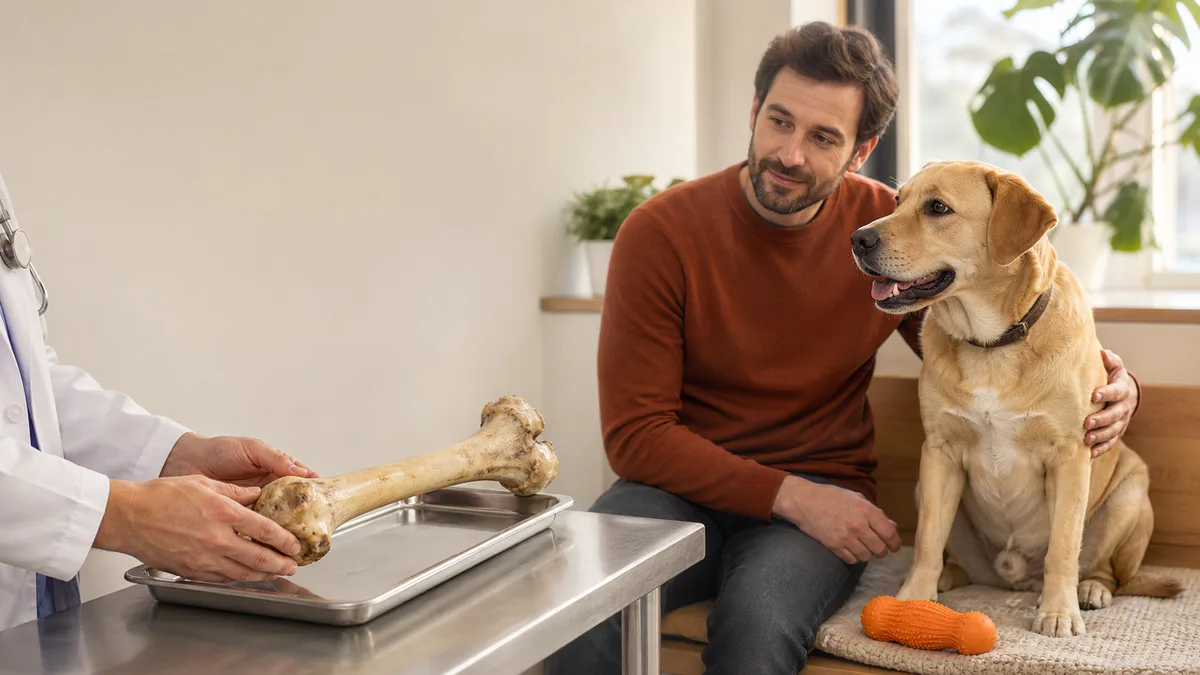
Large, hard, for gnawing. They’re not for eating: the dog scrapes off the meat and cartilage and the bone is taken away.
- Large beef bones with some meat and tendon.
- Beef knuckle or shin, for appropriately sized dogs.
There’s an important caveat with these that usually gets left out: they’re so hard they fracture teeth. Fractured molars from gnawing weight-bearing bones are a frequent reason for veterinary consultation and usually end in extraction or root canal. If your dog is a heavy chewer, this type of bone is more problem than benefit.
A practical test before giving any hard bone: press it with your thumbnail. If it doesn’t give at all, it’s too hard for your dog’s teeth.
Bones to never give
| Never | Why |
|---|---|
| Any cooked bone | Splinters into sharp fragments |
| Bones cut lengthways | The cut leaves sharp edges and exposes the marrow |
| Small poultry bones for gulpers | Swallowed whole: choking and obstruction |
| Bones smaller than their mouth | Can be swallowed in one go |
| Very hard weight-bearing bones for heavy chewers | Frequent cause of dental fracture |
| Marrow-rich bones for dogs prone to pancreatitis | Marrow is very fatty and can trigger an episode |
| Smoked, pressed or treated “shop” bones | They swell, fragment or contain additives |
How to give them with minimum risk
If you decide to give raw bones, these conditions aren’t optional:
- Always supervised. No exceptions. Most accidents happen when the dog is alone.
- Bigger than their muzzle, so it can’t be swallowed whole.
- Raw and fresh, or thawed in the fridge. Never cooked, not even “lightly done”.
- One at a time and away from other dogs. Competition makes dogs gulp, and that’s where things go wrong.
- For a limited time: 10-15 minutes, then take it away. It doesn’t stay down all day.
- Remove it once it wears down to a swallowable size, or as soon as it starts to splinter.
- Raw-meat hygiene: washable surface, washed hands, don’t carry it around the house. The same rules as any raw meat.
- Count the calories. A meaty bone is food; if it’s a regular thing, adjust the ration.
And don’t give bones if your dog has dental disease, has had pancreatitis, swallows without chewing, has had digestive surgery or has a sensitive gut. In those cases the balance doesn’t add up.
What to do if your dog has eaten a cooked bone
This is the most distressing situation and the one that’s worst covered. The rule:
Call your vet and describe what bone it was, what size and when it happened. That’s the only correct opening move.
And meanwhile, three things you must not do:
- Don’t make him vomit. It’s the most common and most dangerous mistake: sharp fragments can do more damage coming up the oesophagus than going down. Vomiting is only induced when a vet says so.
- Don’t give laxatives, oil or paraffin on your own initiative. It can worsen an obstruction or cause aspiration pneumonia.
- Don’t wait “to see if he passes it” if any of the signs below appear.
There is one piece of advice that does get given: offering some bulky, soft food (bread, very well-cooked rice, pumpkin) to wrap the fragments and ease their passage. Check with your vet before doing it, because if they suspect an obstruction they’ll want the dog kept nil by mouth.
Warning signs: vet immediately
- Retching, excessive drooling, pawing at the mouth or inability to swallow: something may be lodged in the mouth or oesophagus.
- Repeated vomiting, especially if he can’t keep water down.
- Abdominal pain: hunched posture, yelping when touched, reluctance to move.
- Marked lethargy, trembling or pale gums.
- No stools, or straining without producing anything.
- Blood in the stools, or black, tarry stools.
- Stops eating for more than 24 hours.
- Difficulty breathing or a persistent cough after the incident.
With any of these, go to emergency care without waiting. An intestinal perforation deteriorates quickly, and the outcome depends heavily on how fast you act.
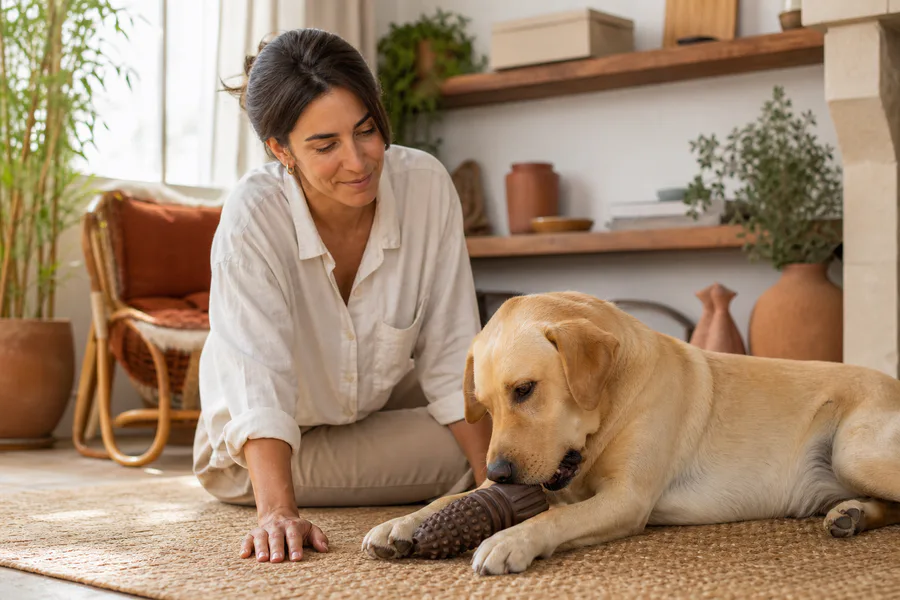
So — bones or no bones?
The honest answer is that there’s no consensus, and anyone who tells you otherwise probably sells something.
- In favour: enrichment and mental stimulation, satisfying the natural urge to gnaw, some mechanical effect on plaque, and a mineral contribution when they’re part of a formulated raw diet.
- Against: dental fracture, choking, obstruction, perforation, constipation and the microbiological risk of raw meat.
Our position, which you’re welcome to challenge: cooked bones, never — there’s no debate there. Raw bones are defensible under the conditions above, but they aren’t essential: a dog can have a perfectly good life without ever gnawing a bone. If what you’re after is entertainment or dental care, there are alternatives with a better benefit-to-risk ratio, and brushing remains the only thing that genuinely prevents periodontal disease.
If you give bones as part of a raw diet, bear in mind that the diet has its own safety and balance considerations; they’re covered in our guide to the BARF diet for dogs. And if your dog has an upset stomach after a bone incident but is otherwise fine, the bland diet for dogs routine applies.
For any doubt about your specific dog — their size, their chewing style, their dental condition — your vet decides.
This guide is informational and does not replace a consultation with your vet.
Keep reading
 Health & wellbeing
 Overweight dog: how to help it lose weight (2026)
If you can't feel your dog's ribs, it's carrying extra kilos. How to check, what to rule out with your vet and a plan so it loses weight at a safe rate.
 Health & wellbeing
 Bland diet for dogs: what to feed, how much and for how long
The chicken-and-rice routine done properly: proportions, real amounts, how long to keep it going, and the signs your dog needs a vet, not a diet.
 Health & wellbeing
 Neutered cat: how much and what to feed it so it doesn't put on weight
Neutering isn't just surgery: it changes your cat's metabolism for life. We explain how much to feed it and how to keep an eye on its weight without obsessing over it.