BARF diet for dogs: an honest guide (benefits, risks and how to start)
Neither miracle nor poison: what the BARF diet really is, its real risks, what vets say and how to do it right if you decide to.

In this article
The BARF diet (Biologically Appropriate Raw Food) means feeding your dog raw food —meat, meaty bones, organ meats and some plant matter— mimicking its ancestral diet. Well formulated, some dogs do really well on it; badly formulated, it’s one of the diets with the highest risk of nutritional imbalance. That’s why the right question isn’t “raw or not”, but how to do it properly. In this guide we tell you, without any hype, what it includes, its real benefits and risks, what vets think and how to start it right —or what safer alternative you have if you’re not sold on raw.
What the BARF diet is (and what the acronym means)
BARF stands for Biologically Appropriate Raw Food. The underlying idea: the dog descends from the wolf and its digestive system is designed to process raw prey —meat, bone, organ meat— better than an ultra-processed kibble full of grain. So BARF proposes going back to that base: raw, unprocessed food.
It’s a logical idea, but with an important catch: “natural” doesn’t automatically mean “balanced”. A wolf eats the whole prey (including gut contents, glands, blood) over several days; a bowl of muscle meat with veg is not the same thing. That’s why the how matters so much.
What it includes: the proportions
There’s no single official “BARF recipe”, but most guidelines hover around this:
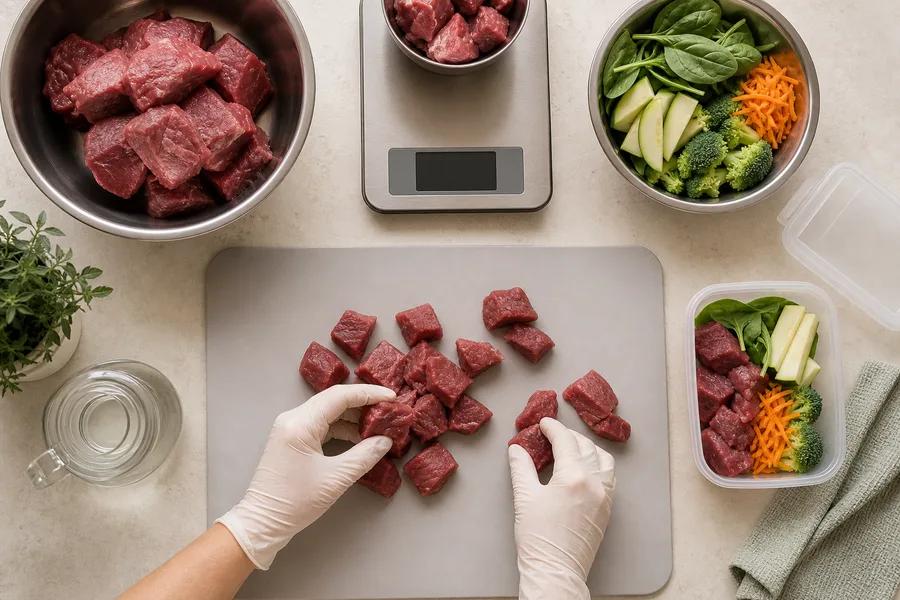
- 70-80% animal-based: muscle meat, meaty bones (raw, never cooked), and organ meats (liver, kidney…).
- 20-30% plant-based: blended vegetables and some fruit.
- Common add-ons: egg, oils, the odd supplement depending on the case.
As a rough amount, an adult dog usually eats around 2-3% of its weight a day (puppies, more). These are ballpark figures: the exact split and the supplements should be adjusted to your dog, ideally with a veterinary nutritionist.
The benefits (with some honest caveats)
Many owners who switch to BARF report improvements. It’s worth putting this precisely: these are associated and frequently observed benefits, not guaranteed dogmas for every dog.
- Smaller, firmer stools (less filler to digest).
- Coat and skin in better condition, more shine.
- Dental hygiene: chewing on pieces helps with tartar.
- Palatability and hydration: lots of water in the food and high acceptance.
Honesty first: part of these improvements is explained by leaving behind a low-end kibble, rather than by the magic of raw itself. A quality cooked food delivers many of these benefits without the risks of raw (we’ll get to that below).
The real risks (this is what whoever’s selling it to you won’t tell you)
Here’s why “is BARF good?” is so controversial. The risks are real and verifiable, especially when the diet is improvised:
- Nutritional imbalance. This is the most common one. A badly calculated homemade BARF tends towards calcium and phosphorus imbalances and vitamin deficiencies or excesses (for example, a lack of vitamin E or an excess of vitamin A from overdoing the liver). In the long run, that takes its toll.
- Microbiological risk. Raw meat can contain salmonella, E. coli or parasites. A healthy dog usually tolerates them, but they’re shed in the stools: it’s a risk for households with young children, pregnant women or immunocompromised people.
- Bones. They provide calcium, but a badly chosen bone can cause splinters, obstructions or constipation. And cooked bones are off-limits: they splinter easily.
None of these risks means BARF is “poison”. They mean it’s not a diet to improvise.
What do vets say?
The mainstream veterinary stance is one of caution, not outright rejection. In practice it boils down to this:
- They don’t recommend it lightly, because they see many badly formulated homemade BARF diets that end in deficiencies.
- They stress the microbiological risk, especially in households with vulnerable people.
- Many accept it if it’s well formulated and supervised (by a professional or through complete commercial menus).
Translation: the problem is rarely the concept; it’s the execution. If you’re going to do BARF, do it right.
How to start it right (if you decide to)
- Don’t improvise the formula. Start from a veterinary nutritionist’s recipe or from ready-balanced commercial menus. Cooking/mixing “by eye” on an ongoing basis is the fast track to deficiencies.
- Gradual transition (7-10 days). Mix more and more new food with the old one. A sudden change is the most common cause of diarrhoea. You’ll find the step by step in our guide to switching from kibble to natural food.
- Strict hygiene. Surfaces, utensils and hands; cold storage; thawing in the fridge.
- Review and adjust. Keep an eye on weight, stools, skin and blood work. For any health condition, veterinary supervision.
The practical alternative: ready-formulated menus (or cooked food)
If natural appeals to you but you don’t want to gamble on the balance or on handling raw meat, you have two sensible shortcuts. Here’s the honest comparison of the three routes:
| Option | What it is | Pros | Cons |
|---|---|---|---|
| Homemade BARF | You buy and calculate | Total control; cheap if you know how to do it | High risk of imbalance; time and hygiene |
| Commercial BARF menus (Wild Balance, Natuka, Naturbarf, Puromenu…) | Raw, already formulated and frozen | Balance sorted; convenient | Price; still raw (microbiological risk) |
| Natural cooked food (COCOSI, Dogfy Diet, Food for Joe, Guau&Cat…) | Cooked at low temperature, already formulated | Balanced and safe (no raw risk); practical | Not “pure” raw |
Natural cooked food is, for most households, the most reasonable middle ground: it keeps almost all the advantages of natural without the microbiological risk of raw. Some brands, like Guau&Cat or Wild Balance, cover both worlds —they offer both BARF and cooked— and also formulate for cats. If you want to see the differences between cooked, BARF and kibble, check out our guide to choosing natural food.
Frequently asked questions
Why do people say the BARF diet isn’t good?
Because badly formulated it has real risks: calcium and phosphorus imbalances, an excess or lack of vitamins, little fibre and problems from bones, plus the risk of pathogens like salmonella when handling raw meat. Well formulated and with good hygiene, those risks drop a lot; the problem is almost always improvising.
How do you make a BARF diet for dogs?
With an animal-based foundation (meat, meaty bone and organ meats) and a plant portion, in a rough proportion of around 70-80% animal and 20-30% plant. The daily amount is about 2-3% of the adult weight. The key is to start from a balanced recipe by a veterinary nutritionist or use ready-formulated menus, make a gradual transition and be scrupulous about hygiene.
What do vets say about the BARF diet?
Most are cautious. They don’t reject it on principle, but they warn that a badly calculated BARF goes off balance easily and that raw meat carries a microbiological risk, especially in households with children or immunocompromised people. If you do it, they recommend it be well formulated and supervised.
What does the BARF diet for dogs include?
Muscle meat, meaty bones (never cooked), organ meats such as liver, and a plant portion of vegetables and some fruit. Many guidelines add extras like egg or oils. The exact proportions depend on the dog and it’s worth adjusting them with a professional.
How much BARF does a dog need per day?
As a reference, an adult dog usually eats around 2-3% of its body weight a day, split across meals. Puppies need a higher percentage and more careful calculation. It’s a rough guide: adjust it to your dog’s body condition and with your vet.
This guide is informational and does not replace a consultation with your vet.
Keep reading
 Nutrition
 Natural dog treats: which to give and which to avoid (2026)
Not everything sold as a natural treat is safe. We cover what to check before buying, what to avoid and where to find them, with real prices.
 Nutrition
 My dog won't eat kibble: causes and when to worry
A dog that stops eating kibble may be bored, full of treats… or ill. Here's how to tell the difference before you start trying tricks.
 Nutrition
 Raw (BARF) diet for cats: real risks, portions and what vets actually say
Neither demonised nor idealised: what the evidence says about raw feeding in cats, the toxoplasma risk almost nobody mentions, and how to reduce it.