Raw (BARF) diet for cats: real risks, portions and what vets actually say
Neither demonised nor idealised: what the evidence says about raw feeding in cats, the toxoplasma risk almost nobody mentions, and how to reduce it.
In this article
A raw BARF diet for cats — raw meat, organ meat and meaty bone — carries documented risks that veterinary bodies consider to outweigh its demonstrated benefits. The AVMA explicitly discourages feeding raw animal protein to dogs and cats, and an FDA study found raw pet foods to be contaminated with pathogens more often than any other type. That doesn’t mean every raw-fed cat will get ill. It means anyone choosing it should know exactly what they’re taking on — and there’s a cat-specific risk, toxoplasma, that is almost never mentioned.
This article comes with one caveat worth stating up front: search Google for “is a raw diet recommended for cats?” and the answer shown most prominently today comes from a brand that sells raw food. We don’t sell food. Not raw, not kibble, nothing.
What a raw diet actually is for a cat
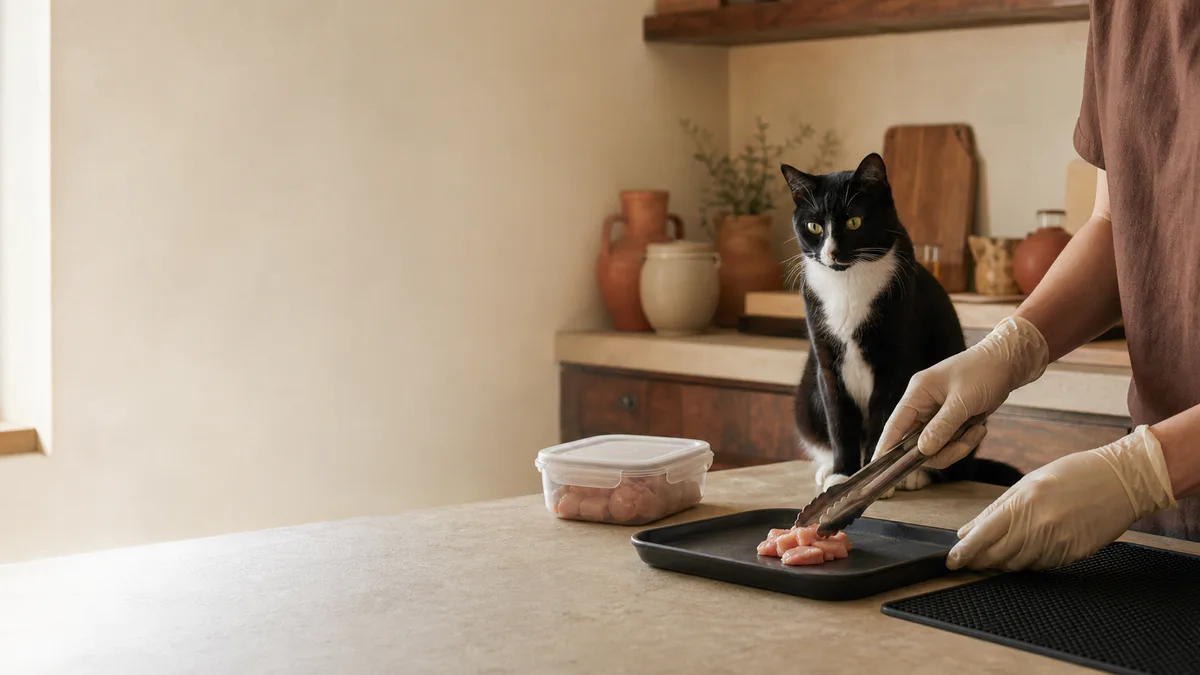
BARF stands for Biologically Appropriate Raw Food. The underlying idea is to feed a cat what a wild feline would eat: whole prey, raw. In practice that means a mix of muscle meat, organ meat, meaty bone and, depending on the school of thought, some plant matter.
For cats, the premise has a point in its favour: they are genuinely obligate carnivores, far more so than dogs. They need animal protein, preformed taurine and moisture, and a permanently dry diet isn’t their ideal scenario. That’s the reasonable part of the raw-feeding argument, and it shouldn’t be dismissed.
The problem isn’t the concept. It’s the execution and what comes with it.
The risks, with data
Microbiological contamination
This isn’t a theoretical precaution. In a two-year study by the FDA’s Center for Veterinary Medicine, of 196 raw pet food samples, 15 tested positive for Salmonella and 32 for Listeria monocytogenes. The agency’s conclusion was that, compared with the other food types tested, raw was more likely to be contaminated.
Reviews of commercial sampling in North America and Europe find Salmonella positivity rates ranging roughly from 7 % to 21 % depending on the study; a Dutch survey found Salmonella in 20 % of the commercial raw food samples analysed.
The list of pathogens the AVMA associates with raw animal protein includes Salmonella, Campylobacter, Clostridium, E. coli, Listeria monocytogenes and others.
And here’s what’s most often overlooked: the cat doesn’t have to get sick for there to be a problem. An apparently healthy animal can shed pathogens in its faeces. Salmonella shedding has been documented for 1 to 11 days after a single day of eating contaminated raw food. And household cleaning routines have been shown to be poor at eliminating Salmonella from food bowls.
Toxoplasma: the cat-specific risk
This is the section that separates cats from dogs, and it rarely appears in commercial guides.
The cat is the definitive host of Toxoplasma gondii: the only species in which the parasite completes its cycle and produces oocysts that pass out in faeces. The main route by which a cat becomes infected is eating infected raw meat.
The veterinary literature records that raw-fed cats show higher toxoplasma seroprevalence and greater oocyst shedding. And toxoplasmosis is a zoonosis with serious consequences for two specific groups: pregnant women — because of the risk of congenital toxoplasmosis — and immunocompromised people.
Two important qualifications, so as not to over-alarm:
- Infection does not happen by stroking the cat or living with it, but through contact with faeces (litter tray, garden soil) and subsequent ingestion. Oocysts also need 1 to 5 days in the environment to become infective: emptying the litter tray daily hugely reduces the risk.
- The raw meat we eat is also a common route of human infection. Toxoplasma is not exclusive to cats.
Even so, if there’s a pregnant or immunocompromised person in the household, feeding the cat raw meat adds an avoidable risk. That’s a decision to discuss with your doctor and your vet, not to settle by reading a blog.
Nutritional imbalance
A diet of meat alone, unformulated, is not a complete diet. The typical failures are an unbalanced calcium-to-phosphorus ratio (meat without bone, or with too much), excess vitamin A from over-feeding liver, and taurine deficiency, which in cats is especially serious.
This isn’t theory: there is a published case of a kitten that developed metabolic bone disease and central retinal degeneration through the nutritional inadequacy of an all-meat raw diet. Both of the taurine-deficiency injuries we describe in our guide to taurine for cats, documented in a single animal because of a badly designed recipe.
And watch out for a counterintuitive detail: taurine is water-soluble, so it’s lost with handling liquids. Meat being raw doesn’t on its own guarantee that enough taurine arrives.
Bones
Raw meaty bone is part of the raw-feeding approach, and it carries its own risks: dental fractures, choking, obstruction and, worst case, perforation of the digestive tract. Cooked bone should never be given because it splinters — but raw isn’t harmless either.
What veterinary bodies actually say
It’s worth reading this literally, because it tends to get reported with a slant in both directions:
- The AVMA (American Veterinary Medical Association) discourages feeding raw or undercooked animal-sourced protein to dogs and cats because of the risk to human and animal health, and supports processing methods that reduce or eliminate that risk.
- The FDA warns of the public health risk and publishes safe-handling guidance for those who choose to feed it anyway.
- The reference review in the literature (Freeman et al., JAVMA 2013) concludes that raw meat carries an inherent risk of bacterial and parasitic contamination, and that animals consuming it may pose a risk to other pets and to people.
What they do not say: that raw diets kill cats en masse, or that anyone feeding one is irresponsible. They say the risk is documented and that the claimed benefits — better coat, better digestion, cleaner teeth — are not backed by evidence of the same quality. It’s an asymmetry of evidence, not a condemnation.

Portions: how much raw food a cat needs
The general reference is 2 % to 4 % of body weight per day, that is, roughly 20-40 grams per kilo.
| Cat’s weight | Approximate daily ration |
|---|---|
| 3 kg | 60-120 g |
| 4 kg | 80-160 g |
| 5 kg | 100-200 g |
| 6 kg | 120-240 g |
One honest detail that’s rarely mentioned: the brands themselves don’t agree. Some recommend 25-30 g per kilo and others 40 g per kilo for the same cat. That spread isn’t a technicality: for a 5 kg cat it’s 125 g versus 200 g a day, a 60 % difference. It’s the best proof that the ration doesn’t come from a generic table, but from the age, activity, reproductive status and body condition of the individual animal.
Growing kittens and pregnant or lactating queens need considerably higher proportions, and they’re precisely the groups in which a nutritional error does the most damage.
If you decide to feed it anyway: reducing the risk
It isn’t our place to decide for you. If you accept the risks, these measures genuinely reduce them:
- Have it formulated by a veterinary nutritionist. Not an internet recipe or your own calculation. It’s the only way to avoid imbalance, and it’s what separates a serious raw diet from a problem.
- Choose a complete, frozen commercial product from a manufacturer with controls, rather than butcher’s meat prepared at home. Traceability matters.
- Freeze before serving. Proper freezing inactivates toxoplasma cysts and other parasites. It does not kill Salmonella or Listeria: it’s a layer of safety, not a steriliser.
- Defrost in the fridge, never at room temperature or in the sun.
- Kitchen hygiene to human food standards: dedicated board and utensils, handwashing, surface disinfection. Treat your cat’s meat the way you’d treat raw chicken for yourself.
- Wash the bowl after every meal, and remove uneaten food after 20-30 minutes.
- Empty the litter tray daily, wearing gloves. If there’s a pregnant person in the house, someone else should do it.
- Regular vet check-ups with weight monitoring and blood work. If something is drifting out of balance, it shows in a blood test before it shows in the coat.
Who shouldn’t feed it
- Households with babies, elderly, pregnant or immunocompromised people.
- Cats with immunosuppression, inflammatory bowel disease, kidney failure or a history of pancreatitis, unless a vet indicates otherwise.
- Anyone who can’t maintain the cold chain or strict hygiene consistently. A badly handled raw diet is worse than any kibble.
So what’s the alternative?
If what appeals about raw feeding is giving real food, with moisture and without ultra-processing, there’s a reasonable middle ground: gently cooked food, which retains much of the palatability and digestibility while eliminating the microbiological risk, and good-quality natural wet food. Both cover the strong argument for raw — moisture and animal protein — without the uncomfortable part.
You’ll find the options compared in our guide to natural cat food and in our best wet cat food comparison. And if your cat is neutered, portion adjustment is covered in feeding a neutered cat.
Whatever you decide, have your cat’s diet signed off by your vet. They know the history and can spot early what an article can’t see.
Sources: American Veterinary Medical Association policy on raw animal-sourced protein in dog and cat diets; FDA Center for Veterinary Medicine study on pathogens in pet foods (2010-2012); Freeman LM et al., “Current knowledge about the risks and benefits of raw meat-based diets for dogs and cats”, JAVMA 2013; review of microbiological hazards of raw diets in Journal of Small Animal Practice; Lenox C, Becvarova I, Archipow W, “Metabolic bone disease and central retinal degeneration in a kitten due to nutritional inadequacy of an all-meat raw diet”, JFMS Open Reports 2015.
This guide is informational and does not replace a consultation with your vet.
Keep reading
 Nutrition
 Natural dog treats: which to give and which to avoid (2026)
Not everything sold as a natural treat is safe. We cover what to check before buying, what to avoid and where to find them, with real prices.
 Nutrition
 My dog won't eat kibble: causes and when to worry
A dog that stops eating kibble may be bored, full of treats… or ill. Here's how to tell the difference before you start trying tricks.
 Nutrition
 Taurine for cats: what it does, how much they need and which foods contain it
Cats can't make enough taurine, and a deficiency damages the heart and eyes. How much they need, where it's found, and the cooking mistake that destroys it.