Taurine for cats: what it does, how much they need and which foods contain it
Cats can't make enough taurine, and a deficiency damages the heart and eyes. How much they need, where it's found, and the cooking mistake that destroys it.
In this article
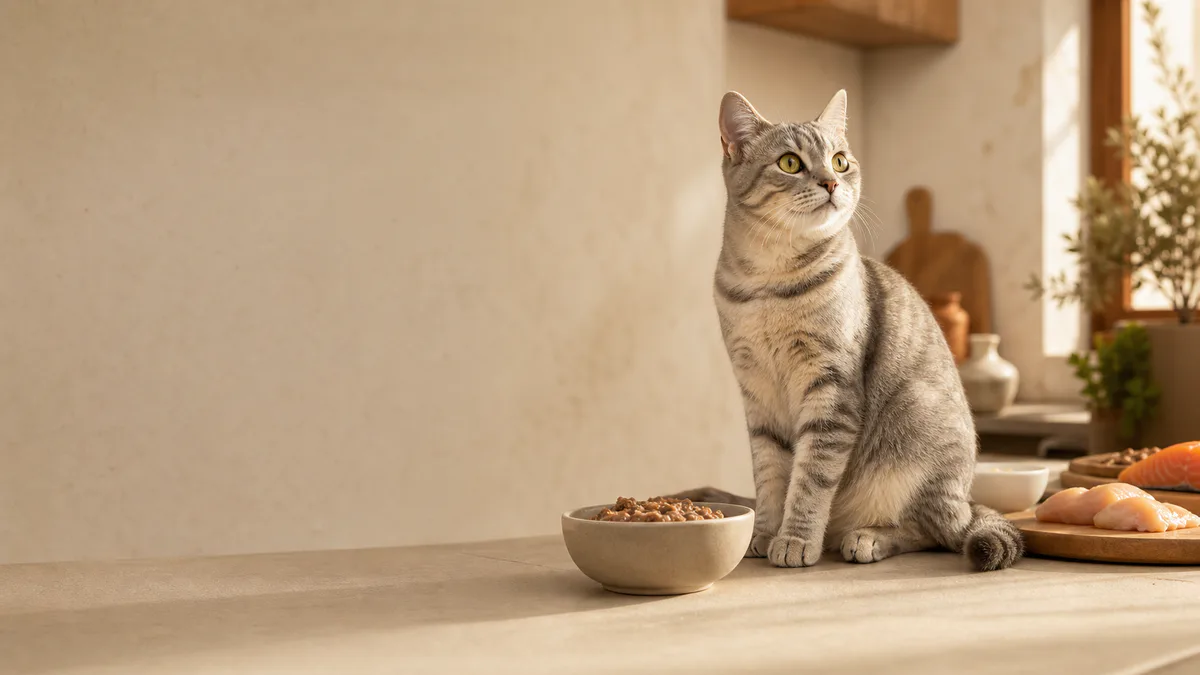
Taurine is an amino acid that cats need to receive ready-made in their food, because unlike dogs they can barely produce it. Without enough of it, they eventually develop two serious problems: dilated cardiomyopathy — the heart enlarges and pumps less effectively — and retinal degeneration, which can end in blindness. A complete kibble or wet food for cats already has it added and covers requirements comfortably. The real risk lies in improvised homemade diets, in food designed for dogs, and — very few people know this — in a cooking mistake that sends most of the taurine down the drain.
Why cats depend on taurine and dogs don’t
Almost all mammals make taurine from two other amino acids, cysteine and methionine. Cats do too, but their capacity to do so is very limited: they lack sufficient quantities of the necessary enzymes. At the same time, they lose taurine continuously through bile, because cats are obliged to use it to form bile salts and cannot substitute another molecule the way dogs can.
Low production and obligatory loss: that’s why taurine is essential in the feline diet and not in the canine one. And it’s the perfect illustration of why a cat is not a small dog, and can’t live on dog food.
Its main roles:
- Heart: required for normal contraction of the heart muscle.
- Vision: concentrated in the retina, where it protects the photoreceptors.
- Fat digestion: forms the bile salts that emulsify fat.
- Reproduction and growth: deficiency causes miscarriages, weak litters and kittens that fail to develop properly.
- Immune and nervous systems, in a more secondary role.
What happens when it’s missing: the two problems to know about
Taurine deficiency doesn’t show up overnight. It takes months to appear, and that delay is exactly what makes it dangerous: by the time symptoms show, the damage has been building for some time.
Dilated cardiomyopathy (DCM). The heart dilates and loses pumping power. It shows as tiredness, rapid breathing, exercise intolerance and, in advanced cases, heart failure. It’s the best known because its history changed the industry: when taurine was identified as the cause in the 1980s, manufacturers began adding it systematically and incidence collapsed. Caught early and with the diet corrected, much of the cardiac damage can be reversed.
Central retinal degeneration. The central area of the retina deteriorates progressively. At first the cat compensates so well that nothing shows; by the time an owner notices poor vision, the lesion is usually advanced. Unlike the heart, this damage does not recover: it can be halted, not reversed.
If your cat has breathing symptoms, unusual tiredness, bumps into things or shows changes in visual behaviour, that’s a vet visit, not a diet question you can resolve by reading. Diagnosis requires examination and, where indicated, echocardiography or a fundus examination.

How much taurine a cat needs
There’s a common confusion here: taurine isn’t prescribed in “milligrams per day” for a healthy cat. Nutritional guidelines define it as a minimum concentration in the food, because what matters is nutrient density in what they eat, not a daily tablet.
According to FEDIAF guidelines (the European manufacturers’ federation, the reference in Spain) for an adult cat at maintenance:
| Type of food | Minimum taurine (per 100 g dry matter) |
|---|---|
| Dry food (kibble) | 0.10 g |
| Canned wet food | 0.20 g |
The US AAFCO minimums match: 0.10 % for extruded and 0.20 % for canned.
Why does wet food need double? It isn’t a regulatory quirk. In wet foods, heat processing in the presence of water degrades more taurine, and canned product also encourages the cat’s gut flora to degrade part of what reaches the intestine, increasing faecal losses. More losses means a bigger starting margin is needed.
The practical consequence for you: if a food declares itself “complete” for cats and meets FEDIAF, taurine is covered and you don’t need to do anything else. If it’s “complementary”, it can’t be the basis of the diet.
Which foods contain taurine (and how much)
This is the part you’ll almost never find with actual figures. The data below come from measurements by the School of Veterinary Medicine at the University of California-Davis on animal feed ingredients, converted to milligrams per 100 g of fresh weight:
| Food | Approximate taurine (mg/100 g fresh) |
|---|---|
| Turkey, dark meat | ~306 |
| Chicken, dark meat (thigh, drumstick) | ~169 |
| White fish | ~151 |
| Chicken viscera | ~100 |
| Fish (average across species) | ~114 |
| Heart | ~65 |
| Liver | ~69 |
| Prawns and shrimp | ~31-39 |
| Chicken, white meat (breast) | ~18 |
Three takeaways worth more than the whole table:
- Dark meat has roughly ten times more than white. Chicken thigh has nearly ten times the taurine of breast. If you’ve ever read that “chicken breast is the healthiest thing for a cat”, now you know why that’s poor advice if it’s going to be the basis of their diet.
- The harder a muscle works, the more taurine it stores. That’s why heart, organ meats and dark meat always beat lean cuts.
- No single fresh food guarantees balance on its own. These figures are for understanding, not for calculating a diet at home: that requires professional formulation.
The cooking mistake that ruins taurine
This is the point almost nobody makes, and the one most people get wrong when cooking for their cat.
Taurine is water-soluble. It isn’t that heat destroys it wholesale: it’s that it escapes into the cooking liquid. If you boil the meat and throw away the water, you throw away most of the taurine with it.
The UC Davis measurements make it clear. Chicken leg goes from around 337 mg/kg raw to around 229 mg/kg baked, and collapses to around 82 mg/kg when boiled and drained: a loss of close to 75 %. The same happens with liver, with drops of the same magnitude between raw and boiled-and-drained. And the figure that confirms it: the broth left from boiling breast meat concentrates taurine, because that’s exactly where it has gone.
What to do about it:
- If you cook for your cat, use methods that retain the juices (oven, pan, steam) rather than long boiling.
- If you do boil, use the broth — unsalted, no onion, no garlic — and serve it with the food instead of pouring it away.
- And above all: don’t assume a homemade diet covers taurine just because it contains meat. Between the natural variability of the ingredient and cooking losses, the margin for error is enormous.
Do you need to supplement?
It depends on what your cat eats:
- Complete commercial food (kibble or wet food declared “complete” for cats): no. Taurine is already added in sufficient quantity. Supplementing on top adds nothing.
- Homemade or raw diet: yes, almost always, and not improvised. Fresh meat alone rarely hits the target reliably, given ingredient variability and handling losses. A homemade feline diet should be formulated by a veterinary nutritionist, who will calculate whether a supplement is needed and how much.
- A cat diagnosed with cardiomyopathy or a retinal problem: the protocol is set by the vet, not by an article.
On excess: taurine has a very wide safety margin and cats excrete the surplus in urine, so nutritional guidelines set no maximum toxicity level. Even so, supplementing without reason into an already calculated diet isn’t harmless: it unbalances the formula and, if the cat has symptoms, delays the real diagnosis. The answer to “I’ll give taurine just in case” is almost always to review the diet, not to add things to it.
How to be sure without overcomplicating it
- Make sure the food says “complete” for cats, not “complementary”, and is formulated to FEDIAF or AAFCO. That’s it, done.
- Don’t base their diet on dog food. Canine foods aren’t required to cover taurine in the same quantities because dogs don’t need it the same way. The occasional mouthful is fine; as a diet, it’s a real risk.
- Be careful with breast meat as a sole dish. It’s the cut lowest in taurine.
- If you cook, don’t throw away the water.
- If you want a homemade or raw diet, go through a veterinary nutritionist. It’s the only way to be certain.
If you’re deciding what to feed, you’ll find the full picture in our guide to natural cat food and in our best wet cat food comparison, where moisture and taurine are two of the selection criteria. And if your cat is neutered, portion adjustment is covered in feeding a neutered cat.
Sources for composition data: taurine concentration measurements in animal feed ingredients from the School of Veterinary Medicine, University of California-Davis (Spitze et al.), and FEDIAF 2024 nutritional guidelines and AAFCO nutrient profiles for cats.
This guide is informational and does not replace a consultation with your vet.
Keep reading
 Nutrition
 Natural dog treats: which to give and which to avoid (2026)
Not everything sold as a natural treat is safe. We cover what to check before buying, what to avoid and where to find them, with real prices.
 Nutrition
 My dog won't eat kibble: causes and when to worry
A dog that stops eating kibble may be bored, full of treats… or ill. Here's how to tell the difference before you start trying tricks.
 Nutrition
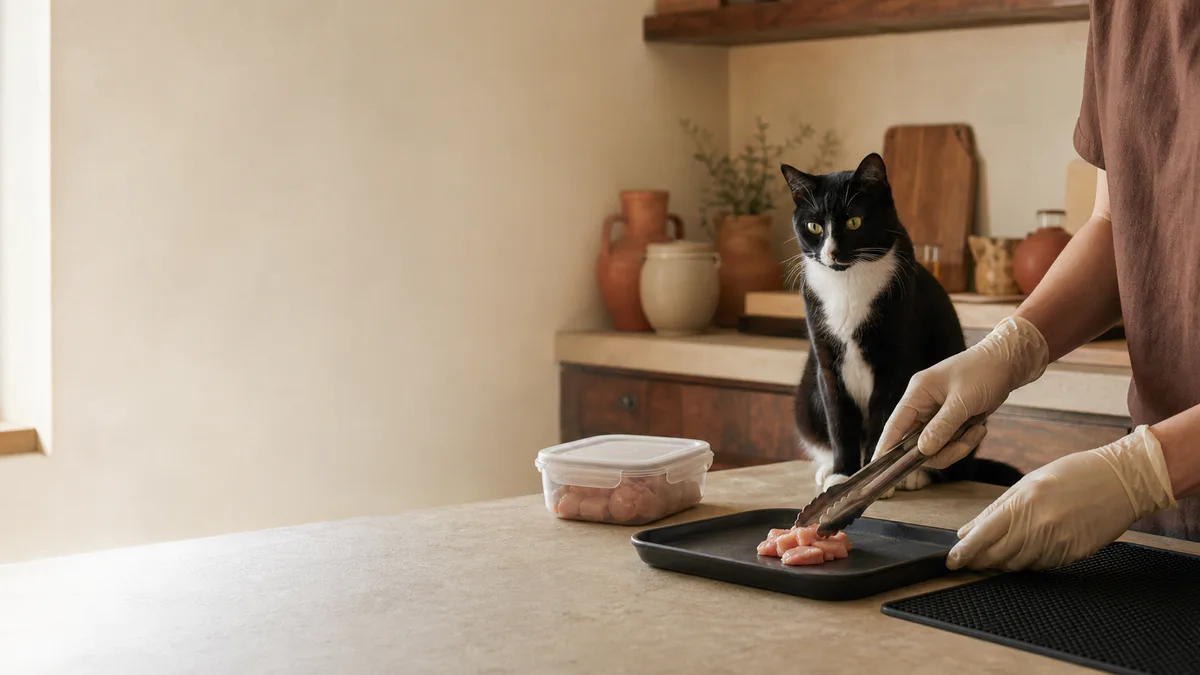
 Raw (BARF) diet for cats: real risks, portions and what vets actually say
Neither demonised nor idealised: what the evidence says about raw feeding in cats, the toxoplasma risk almost nobody mentions, and how to reduce it.