Neutered cat: how much and what to feed it so it doesn't put on weight
Neutering isn't just surgery: it changes your cat's metabolism for life. We explain how much to feed it and how to keep an eye on its weight without obsessing over it.

In this article
Neutering your cat isn’t just surgery: it changes its metabolism for the rest of its life. After the operation, energy expenditure drops by 20 to 30%, and if you keep feeding the same portion as before, excess weight is almost guaranteed to follow. The good news is that it’s easy to prevent with two simple adjustments: less food (or a lower-calorie formula) and keeping an eye on body condition, not just the number on the scale. Here’s how to get it right.
Why feeding changes after neutering
Neutering removes the sex hormones, which among other things influence metabolism and appetite. The result most often cited by vets is a reduction in resting energy expenditure of between 20 and 30% compared with an intact cat of similar weight. On top of that, some neutered cats also become less physically active and gain a bit more appetite, a combination that explains why excess weight is so common in neutered cats if the diet isn’t adjusted.
This doesn’t mean neutering is a bad thing —it has well-established health and behavioural benefits— but it does call for a conscious nutritional adjustment that many owners never make, simply because no one explains it to them.
How much a neutered cat should eat
There’s no universal figure that works for every cat, but there is a clear logic to follow:
- Cut the portion by 20-30% compared with what you’d give an intact cat of the same weight, as a starting point.
- Check the manufacturer’s table for your specific kibble or food: most give grams per kilo of body weight and activity level, and some already have a specific column for “neutered”.
- Adjust according to how your cat actually responds, not just the table: if it gains weight, cut back a bit more; if it loses too much, increase it.
- Weigh it regularly (every 1-2 months is reasonable) to catch changes early, when they’re easier to correct.
As a general guide, kibble “for neutered cats” isn’t essential: these are formulas with a lower calorie density and often more fibre for satiety, which makes control easier, but you can get the same result by adjusting the amount of its usual kibble.
Can it stay on its normal kibble?
Yes. A neutered cat can stay on the same food as before: what changes isn’t necessarily the type of food, but the amount. That said, if your cat tends to beg for food constantly or struggles to feel full on a smaller amount, a specific “light” or “neutered” formula (with a lower calorie density) can help it eat a similar volume without going over on calories.
How to tell if its weight is right
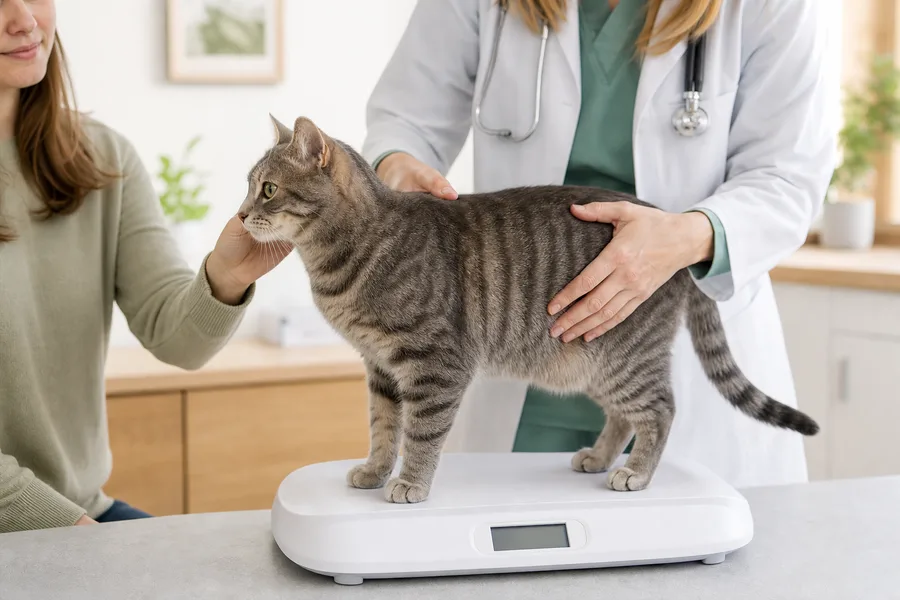
The scale alone doesn’t tell the whole story —ideal weight varies a lot by breed and build—. The most reliable measure is body condition, something you can assess yourself at home:
- Ribs: you should be able to feel them with gentle pressure from your hand, but without seeing them clearly.
- Waist: looking at your cat from above, there should be a slight waist behind the ribs, not a straight or broadening silhouette.
- Belly: it shouldn’t hang or sway noticeably as it walks.
If you’re not sure what this should look or feel like, ask your vet to show you at the next check-up: it’s a skill you pick up quickly and one that’s useful for the rest of your cat’s life.
Common mistakes that lead to excess weight
- Leaving food out ad libitum. This makes it hard to know how much your cat actually eats in a day, especially if there’s more than one cat in the house. It’s better to split its calculated portion into 2-4 meals.
- Not reducing the amount after neutering, simply because no one warned you it was necessary.
- Making up for it with treats and snacks — calories “taken away” from the main portion but never counted in the daily total.
- Not weighing the portion, and instead guessing “by eye” with a cup or scoop that isn’t accurate.
Beyond diet, your cat’s wellbeing also depends on its day-to-day behaviour. If you have questions about the litter box or scratching, we have specific guides on how to litter-train a cat and on why cats scratch furniture and how to redirect it.
Frequently asked questions
How much should a neutered adult cat eat?
As a rough guide, after neutering a cat’s energy expenditure drops by 20 to 30%, so its portion should be reduced by a similar proportion compared with an intact cat of the same weight. The exact amount depends on the specific kibble or food (check the manufacturer’s tables) and should be adjusted by watching its body condition, not just the number on the scale.
Can a neutered cat eat normal kibble?
Yes, it can stay on its usual kibble, but the amount needs to be adjusted downward because its energy expenditure has dropped. Kibble specifically “for neutered cats” isn’t essential: it’s usually a formula with a lower calorie density and a bit more fibre for satiety, which makes weight control easier, but it’s not the only way to achieve it.
How do I know if my neutered cat’s weight is right?
By its body condition, not just the scale: you should be able to feel its ribs with gentle pressure of your hand, without seeing them clearly, and its waist should be visible from above, with no belly hanging down. If you’re unsure, ask your vet to assess its body condition at the next check-up.
Why do cats put on so much weight after being neutered?
Because neutering reduces their resting energy expenditure, but many owners keep feeding the same amount as before. Without that adjustment, the extra calories build up. On top of that, some neutered cats also become less physically active, which raises the risk even further.
Should I leave food out all day for my neutered cat?
It’s not the best idea. Free access to food (ad libitum) makes it very hard to control how much your cat actually eats in a day. It’s better to split its calculated daily portion into 2-4 meals, or use a controlled-feeding bowl if you tend not to be home at mealtimes.
This guide is informational and does not replace a consultation with your vet.
Keep reading
 Health & wellbeing
 Overweight dog: how to help it lose weight (2026)
If you can't feel your dog's ribs, it's carrying extra kilos. How to check, what to rule out with your vet and a plan so it loses weight at a safe rate.
 Health & wellbeing
 What bones can dogs eat (and which ones are dangerous)
Cooked bones, never. Raw ones, with conditions. Here's the full picture, without the vested interests of whoever is selling kibble or bones.
 Health & wellbeing
 Bland diet for dogs: what to feed, how much and for how long
The chicken-and-rice routine done properly: proportions, real amounts, how long to keep it going, and the signs your dog needs a vet, not a diet.