Why does my cat scratch furniture (and how to redirect it without punishment)
Your cat isn't scratching the sofa to spite you: it's a need as basic as eating. The solution isn't to stop it scratching — it's to get it scratching somewhere else.
In this article
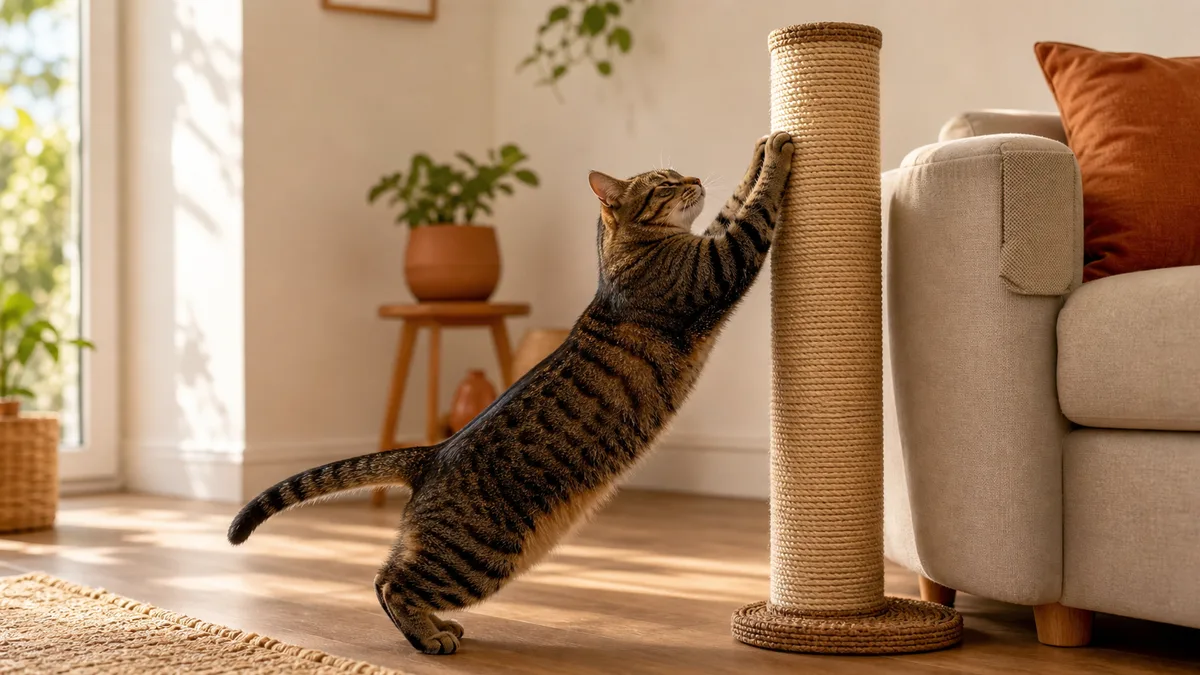
Your cat isn’t scratching the sofa to spite you: scratching is a need as basic as eating or sleeping. It has nothing to do with rebellion or bad manners. The good news is that the goal isn’t to stop it scratching — that’s neither realistic nor desirable — but to get it scratching where it should.
Why cats scratch: it’s not a whim
- Claw maintenance. Scratching helps shed the worn outer layer of the claw.
- Territory marking. Their paws have glands that leave a scent mark (as well as a visual one) that tells other cats the space is taken.
- Physical stretching. Scratching vertically stretches the whole spine and musculature, something a cat needs to do frequently.
- Releasing tension. It also shows up as a way of discharging excitement or momentary stress.
How to choose the right scratching post
Not every scratching post works for every cat. You’ll usually need to experiment a bit:
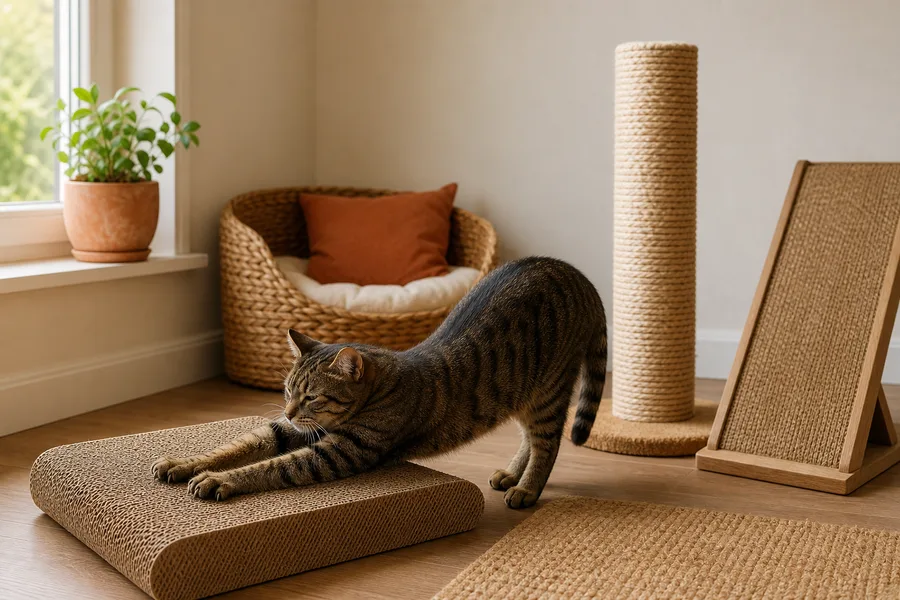
- Material: sisal, corrugated cardboard and carpet are the most common. Look at the texture of whatever your cat is currently scratching — it usually gives you a clue to what it prefers.
- Orientation: vertical (to stretch the whole body) or horizontal (more comfortable for some cats, especially older ones). If you don’t know which it prefers, offer both at once.
- Height and stability: if it’s vertical, it needs to let your cat stretch out fully without wobbling; an unstable post can put it off using it.
Where to put it
- Close to the furniture it’s currently scratching, not tucked away in a corner it never visits: at first, how convenient the location is matters more than anything else.
- In busy spots or places where it spends time awake, since many cats scratch on waking from a nap or on arriving in a familiar area.
- More than one if the house has several floors or several cats, to avoid competition over a single scratching spot.
How to redirect the behaviour with positive reinforcement
- Place the scratching post right next to the furniture it currently scratches, not somewhere else that “looks nicer”.
- Reward it when it uses the post: a treat, a stroke or a bit of play right afterwards reinforces that it’s the right spot.
- Make the furniture temporarily less appealing while it gets used to the post: double-sided tape or aluminium foil on the area it scratches are common deterrents that don’t hurt it.
- Never punish it in the moment (shouting, water, pushing it away): it creates stress, doesn’t teach it where it should scratch, and can undermine its trust in you.
- Be patient: changing the habit takes days or weeks, not one afternoon.
What you should never do: onychectomy (declawing)
Trimming the tips of the claws regularly is a normal hygiene practice. Onychectomy, or declawing, is very different: it means amputating the last bone of each toe, not just the claw. In Spain it’s banned as non-therapeutic mutilation under Law 7/2023 on the protection of the rights and welfare of animals, and for good reason: besides being painful surgery, it can alter the way a cat walks and cause chronic pain or long-term behavioural changes. The real alternative is always to give the need to scratch an outlet, not eliminate it by force.
If your cat is also neutered and you want to fine-tune its diet and weight, we have a specific guide for that stage. And if the issue isn’t scratching but the litter box, here’s how to solve that.
Frequently asked questions
Why does my cat scratch the furniture instead of the scratching post?
It’s almost always because the scratching post doesn’t tick the boxes your cat is after: the wrong material, orientation or height, or it’s tucked away somewhere it barely notices. If the furniture it’s scratching has a similar material or scratching position to the post you’ve given it, try changing those variables first.
Is it bad for my cat to scratch things?
No, it’s a natural and necessary behaviour: it keeps its claws in good condition, marks territory, and lets it stretch its body. The goal isn’t to stop it scratching — it’s to get it scratching somewhere appropriate instead of on the furniture.
Do repellent sprays work to stop cats scratching furniture?
They can help as a temporary measure to make the furniture less appealing while you offer a clear, well-placed alternative, but they don’t replace a good scratching post: without an alternative, the cat will simply look for somewhere else to scratch.
What scratching post should I buy if I don’t know what my cat prefers?
Offer at least two types at the same time (for example, a vertical sisal post and a horizontal cardboard one), somewhere visible and close to where it currently tends to scratch. Over time you’ll see which one it uses more, and you can focus on that model.
Is it legal to trim a cat’s claws or declaw it in Spain?
Trimming the tips of the claws regularly is a normal, recommended hygiene practice. Onychectomy, or declawing (amputating the last bone of each toe), is a different matter: it’s banned in Spain as non-therapeutic mutilation under Law 7/2023 on the protection of the rights and welfare of animals.
Keep reading
 Training & care
 My cat meows a lot at night: causes and what to do
Before blaming boredom, look at your cat's age: in an older cat, new night-time meowing can be a medical warning. Causes, a night plan and when to book a vet visit.
 Training & care
 Separation anxiety in dogs: what to do about it (2026)
Not everything that looks like separation anxiety is. Before assuming it, check the other causes that produce the same symptoms and what to do in each case.
 Training & care
 How much natural food your dog needs by weight (table by brand)
The neutral gram-by-weight table you can use with any brand, plus an honest rundown: who has a real calculator and who's just saying they do.