How much natural food your dog needs by weight (table by brand)
The neutral gram-by-weight table you can use with any brand, plus an honest rundown: who has a real calculator and who's just saying they do.
In this article
The general reference for a healthy adult dog is 2-3% of its body weight per day in natural food, with 2.5% as a middle figure: about 125g at 5kg, 375g at 15kg and 750g at 30kg. This is the table you can use with any brand, because it doesn’t depend on one in particular — and it’s a different question from cost, which we already answered in how much natural dog food really costs per month.
Here we focus only on the amount: the neutral table, how each brand in the sector calculates it, and why “personalised by breed” is, in most cases, more slogan than nutrition.
The neutral table: grams per day by weight
Using 2.5% of body weight as the reference for an adult with moderate activity:
| Dog’s weight | Daily ration (2.5%) | Reasonable range (2-3%) |
|---|---|---|
| 5 kg | 125 g | 100 - 150 g |
| 10 kg | 250 g | 200 - 300 g |
| 15 kg | 375 g | 300 - 450 g |
| 20 kg | 500 g | 400 - 600 g |
| 30 kg | 750 g | 600 - 900 g |
This table is for cooked or raw food, not kibble — kibble carries much less moisture and its ration tables are different. And it’s a starting point: puppies, highly active dogs, neutered dogs or dogs on a weight-loss plan need adjustments covered further down.
How each brand calculates the ration
This is where the sector splits in two: brands that give you a real tool, and brands that just say they do. Checked on 29 August 2026:
| Brand | How it calculates the ration |
|---|---|
| Guau&Cat | Its own step-by-step questionnaire (dog profile) that ends in a personalised plan. |
| Food for Joe | A public calculator on its website, plus an orientative weight table on its blog. |
| Natuka | A menu calculator linked from its website. |
| Dogfy Diet | Calculates the ration internally to build your subscription plan; doesn’t publish generic gram figures. |
| Puromenú | We found no public calculator on its website. |
A brand having a calculator doesn’t mean the others are “guessing” — Puromenú, for instance, guides quantity through each product’s page and direct customer support. But if being able to simulate the ration before buying matters to you, it’s a real difference between brands.

“Personalised by breed”: what’s true and what’s marketing
You’ll read a lot of “rations personalised by weight and breed” in this sector. The weight part is real and central. The breed part deserves a caveat almost nobody makes:
What genuinely determines an adult’s ration: current weight, age, activity level, whether they’re neutered (this cuts energy needs by roughly 20-30%) and body condition. These are the variables that actually change the calculation.
What breed does and doesn’t contribute: in large or giant-breed puppies, breed genuinely matters a lot — they need more controlled growth to protect their joints, unlike a small-breed puppy. But in an adult dog, two dogs of the same breed and the same weight don’t necessarily eat the same amount: one can be far more active than the other, or have a different metabolism. Breed is, at most, an indirect clue about expected adult weight — not a calculation factor in its own right once you already know the dog’s actual weight.
Put differently: if a calculator asks for breed, it’s most likely using it to estimate a puppy’s adult weight or suggest a recipe — not because two dogs identical in weight need different rations for being different breeds.
Signs the ration isn’t right
The kitchen scale tells you how much you’re serving; the dog’s body tells you whether it’s enough:
- Ribs: you should be able to feel them with gentle pressure, without pressing hard, but without seeing them at a glance. If you can’t feel them, that’s excess weight; if they’re very visible, the ration needs increasing.
- Waist: seen from above, there should be a visible narrowing behind the ribs. If the outline is straight or widens, that signals extra weight.
- Gradual adjustment: if you spot excess weight, cut the ration by 10% and reassess in two weeks — not all at once. If weight drops without you intending it, raise the ration by the same margin.
If your dog has an underlying condition, is still growing, or your own adjustment isn’t working after three or four weeks, it’s time for a vet visit — no generic calculator replaces that.

How to weigh the ration correctly
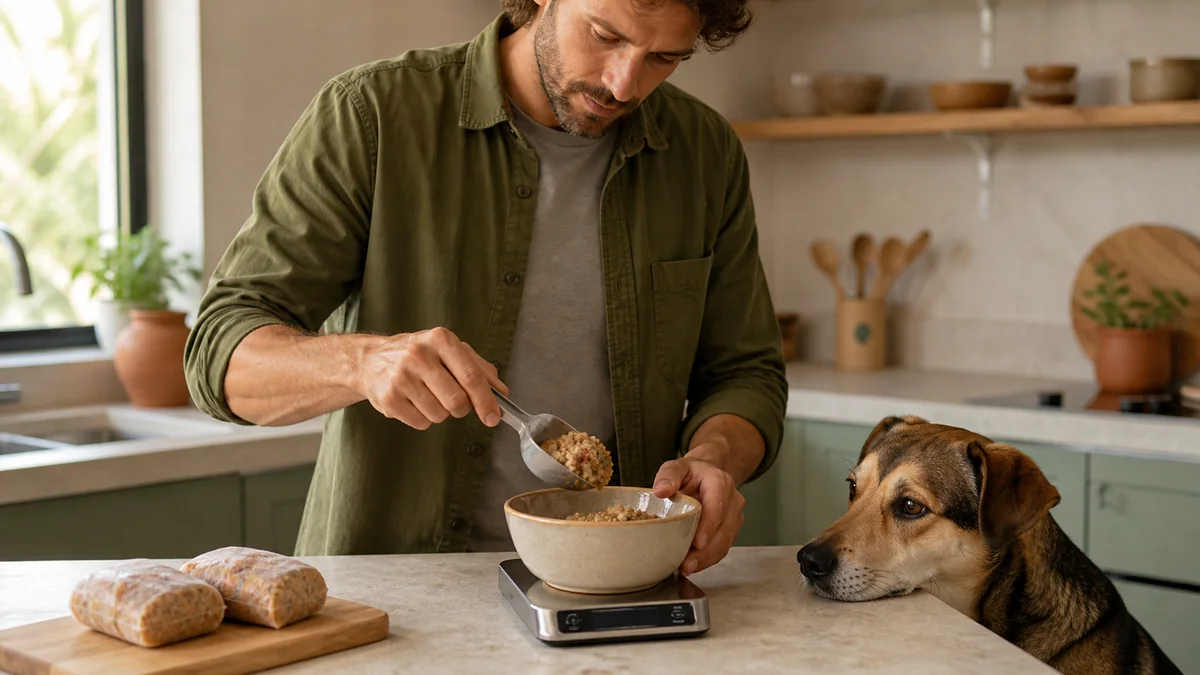
Weigh the food raw, before cooking or thawing — it’s the criterion the brands themselves use when publishing their gram figures, and the one that makes tables from different sources comparable. If you split the daily ration into two meals (the usual approach), weigh the full day’s total and divide it, rather than calculating each meal separately: rounding is much more likely to throw off the real amount that way.
Before changing the amount or type of food
If you’re working out the ration because you’re switching from kibble to natural food, the change in amount should go hand in hand with a gradual transition over 7-10 days — we cover it in how to switch your dog from kibble to natural food. And if you’re specifically weighing a raw BARF diet, the ration is calculated the same way while the handling risks are different — covered in raw BARF diet for dogs.
And the rule we always repeat: the most precise calculator in the world is a starting point, not a substitute for looking at your dog and adjusting based on what you see.
Keep reading
 Training & care
 My cat meows a lot at night: causes and what to do
Before blaming boredom, look at your cat's age: in an older cat, new night-time meowing can be a medical warning. Causes, a night plan and when to book a vet visit.
 Training & care
 Separation anxiety in dogs: what to do about it (2026)
Not everything that looks like separation anxiety is. Before assuming it, check the other causes that produce the same symptoms and what to do in each case.
 Training & care
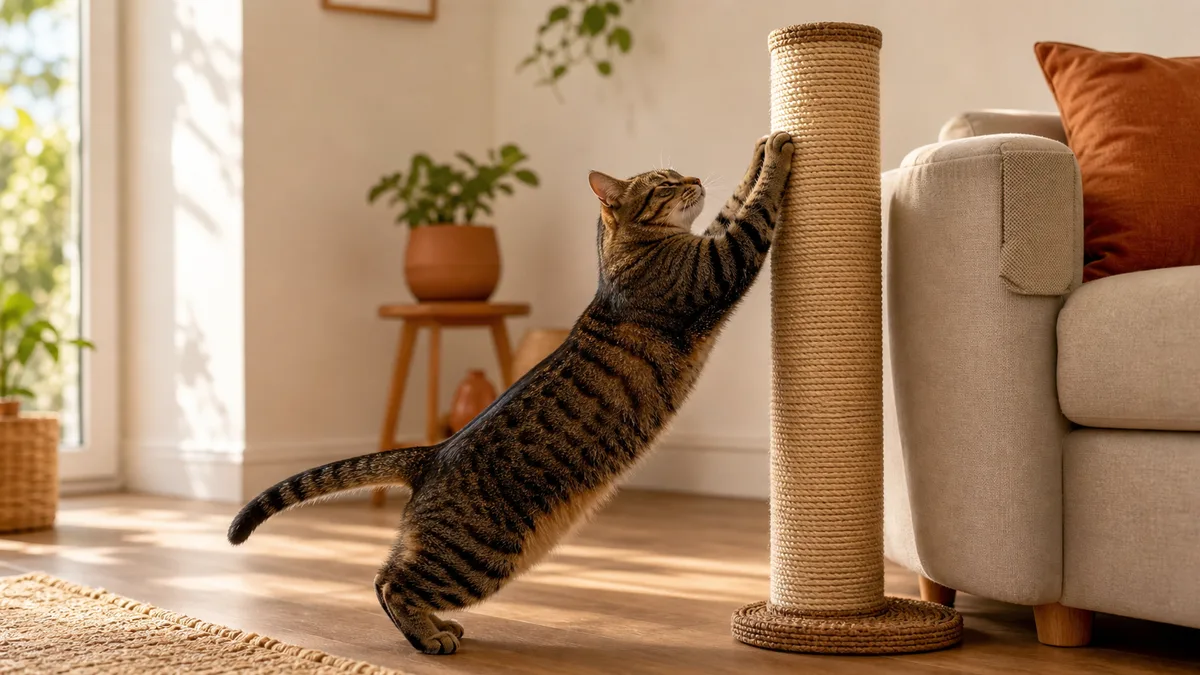
 Why does my cat scratch furniture (and how to redirect it without punishment)
Your cat isn't scratching the sofa to spite you: it's a need as basic as eating. The solution isn't to stop it scratching — it's to get it scratching somewhere else.