Cat diarrhoea: causes and when to see the vet
A cat's diarrhoea is usually brief, but sometimes it hides an illness. What International Cat Care, Cornell and MSD say about causes, food and when to call the vet.
In this article
According to Cornell, cat diarrhoea is usually short-lived, but sometimes it’s a sign of a serious illness. The veterinary sources don’t draw the line in the same place: International Cat Care advises a check if it is severe, if there are other signs of being unwell or if it lasts more than a few days; Cornell, if it goes on for more than a day or two and there is also poor appetite, lethargy or vomiting. Below, the causes, what you can offer at home and the signs that can’t wait, with every fact attributed to its source.
Causes of cat diarrhoea
According to International Cat Care, diarrhoea happens when faeces move through the intestines faster than normal and less water, nutrients and electrolytes are absorbed. These are the causes the veterinary sources list:
| Cause | What the sources say |
|---|---|
| Sudden change of food | It can cause diarrhoea for a few days, according to Cornell’s guide. Kittens may be at higher risk while their digestive system adjusts to solid food |
| Stress | A long car journey or a weekend at the clinic can produce a brief episode of diarrhoea (Cornell) |
| Parasites and protozoa | Giardia appears in up to 39% of faecal samples from domestic and shelter cats, more in young ones (MSD on protozoa). Tritrichomonas foetus is seen mostly in cats under one year old (International Cat Care) |
| Bacteria | Campylobacter causes diarrhoea lasting 5 to 15 days, more severe in cats under 6 months; MSD cites undercooked chicken and other raw meats or dairy products as the suspected source (MSD on bacteria) |
| Viruses | Panleukopenia affects cats of all ages and mostly kittens, with a mortality above 90% in them; indoor cats are also at risk (ABCD factsheet) |
| Underlying diseases | Cornell lists hyperthyroidism and kidney or liver disease, among others; MSD, inflammatory bowel disease and digestive cancers |
| Toxins and plants | Diarrhoea is one of the signs; International Cat Care says not to induce vomiting and to call the vet (toxic plants) |
Cat diarrhoea but eating well: when to worry
Eating normally doesn’t rule out a cause that needs treatment. According to International Cat Care, if the diarrhoea is recent and mild and the cat is still alert and eating, the vet may simply treat the signs and wait.
Some causes come with a normal appetite. In Tritrichomonas foetus infection, most affected cats are otherwise well, eat normally and don’t lose significant weight; and in colitis, MSD says weight loss and vomiting are rare.
If it drags on, ask for a check-up even if your cat is active: International Cat Care stresses that diagnosing the cause of persistent diarrhoea early helps prevent long-term changes that may be irreversible.
What to feed a cat with diarrhoea
None of the veterinary sources we read gives a home recipe. International Cat Care says that switching to a simple, highly digestible diet is often helpful whatever the cause, and asks you to choose it with your clinic because many gastrointestinal diets exist. For the rest, this is what they report:
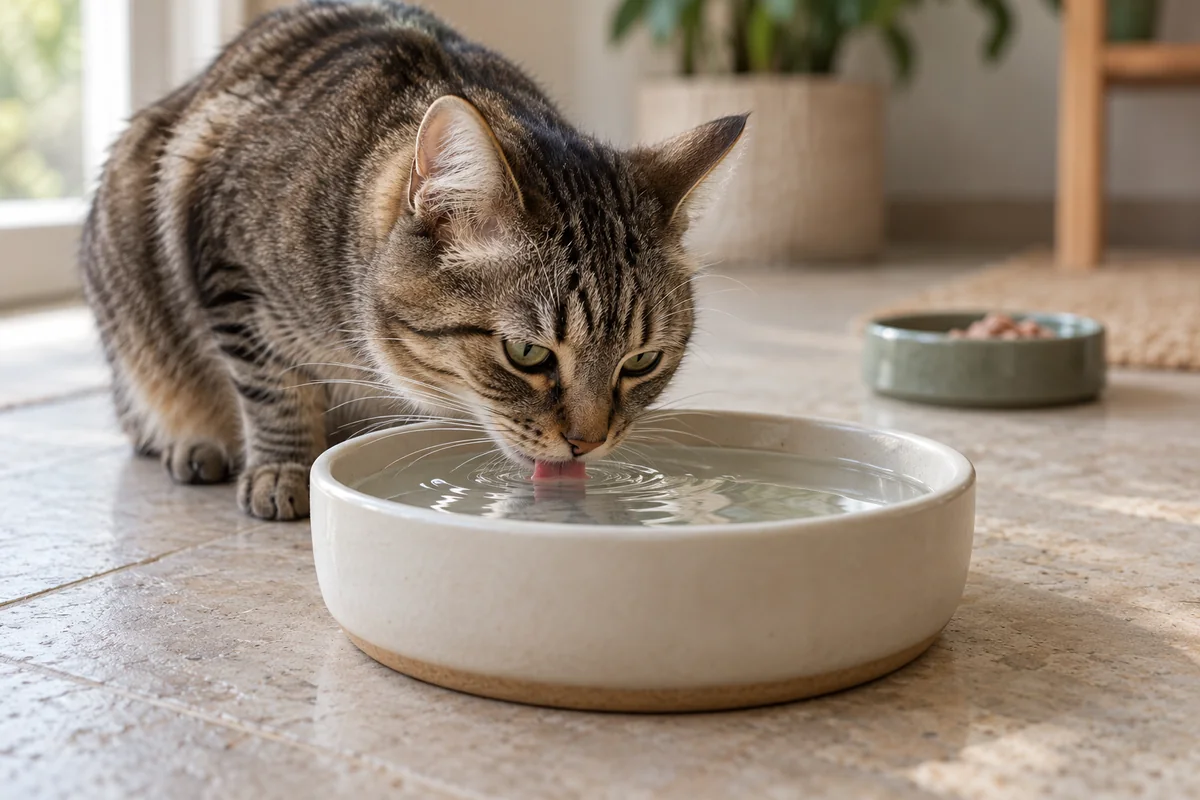
- Water at hand. With severe diarrhoea a cat can become dehydrated; International Cat Care explains that the vet may suggest an electrolyte solution instead of plain water.
- No sudden changes of food. When it’s time to change, International Cat Care suggests offering the old and the new diet in separate bowls, because cats generally don’t like two different foods mixed in one bowl, starting with 75% of the old and 25% of the new. Let the cat set the pace: some accept the change in 5-7 days and others take 2 to 8 weeks.
- No human medication. Cornell warns that some over-the-counter medications can be harmful to cats.
- No fasting on your own. In colitis, the MSD manual explains that you may be asked to withhold food for 24 to 48 hours, always following your vet’s recommendations. And in an overweight cat, lack of appetite or fasting can set the stage for hepatic lipidosis, the most common acquired and potentially fatal liver disease in cats, according to MSD.
When to take a cat with diarrhoea to the vet
The sources set the threshold in different places, so here they are separately:
| Source | When to consult |
|---|---|
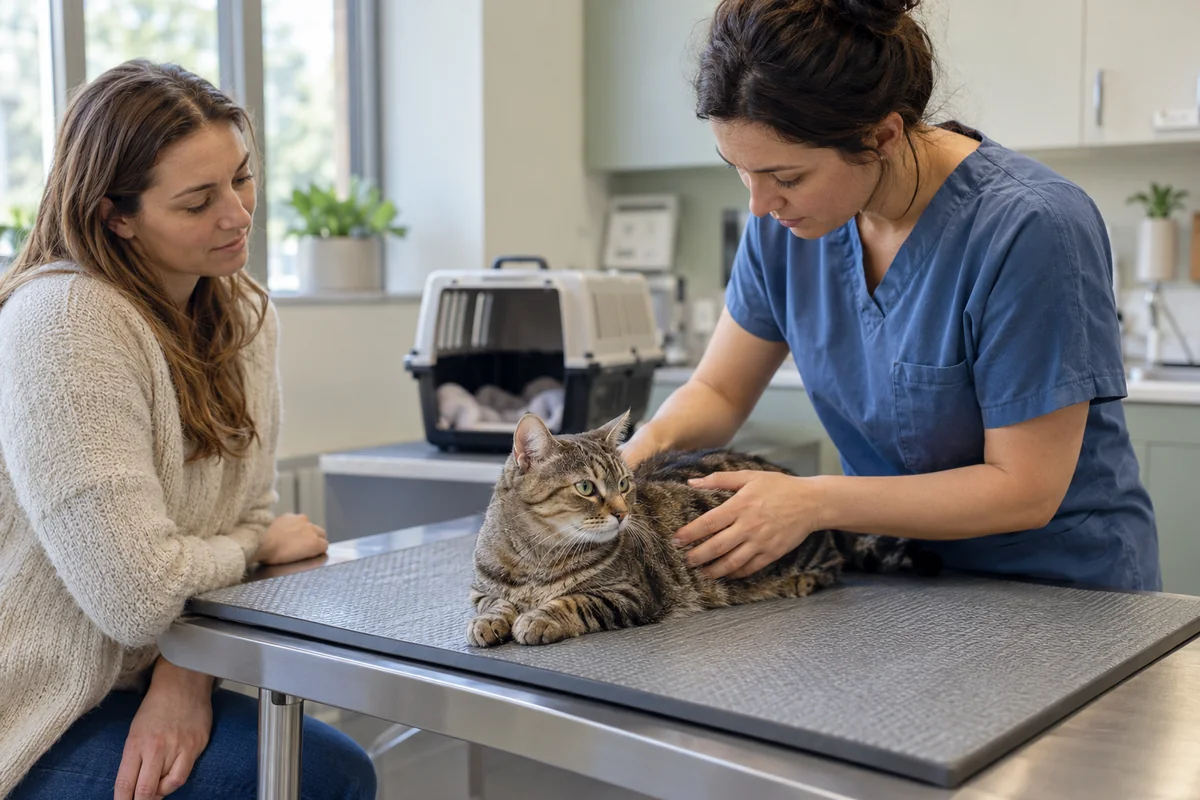
| International Cat Care | If the diarrhoea is severe, if there are other signs of being unwell (for example, not eating normally) or if it lasts more than a few days. Black, tarry faeces mean contacting the vet; blood, unless there’s a lot of it, doesn’t need emergency attention, but the cat should still be checked |
| Cornell | If it goes on for more than a day or two and there is also poor appetite, lethargy or vomiting: as soon as possible |
| MSD and ABCD (kittens) | On the pages we read they set no time limit, but they describe more cases or more severe ones in kittens: panleukopenia (ABCD), coccidiosis and Campylobacter, more severe in cats under 6 months (MSD) |
Because several of these causes are more severe in kittens, don’t wait to see how it goes: call your clinic. And if you suspect it has eaten something toxic, call without inducing vomiting.
Before you go, note what the faeces look like, how many times a day, whether there is straining and whether you see blood or mucus: International Cat Care says this helps the veterinary team narrow down the possible causes. If your clinic asks, bring a fresh sample, which is what’s needed to detect Tritrichomonas foetus.
Natural or raw food and cat diarrhoea
If the diarrhoea came with a recent change of food, a sudden change is one of the causes listed by Cornell and International Cat Care. As for raw meat, MSD cites undercooked chicken and other raw meats or dairy products as the suspected source of Campylobacter, and the WSAVA’s nutrition committee recommends that raw diets not be fed to dogs or cats (its statement on raw diets).
There’s more in our guide to the BARF diet for cats and in the comparison of natural cat food.
What if it’s a dog?
For dogs the guidance is different: see our guide to dog diarrhoea. One practical difference: when changing food, in our transition guide for dogs the old and the new are mixed, whereas for cats International Cat Care advises separate bowls.
Frequently asked questions
What can I give a cat with diarrhoea?
The veterinary sources we read don’t give a home recipe: International Cat Care says a simple, highly digestible diet is often helpful and that it’s best to choose it with your clinic, because many gastrointestinal diets exist. Keep water always available and don’t change food suddenly.
When should a cat with diarrhoea see the vet?
It depends on the source: International Cat Care advises a check if it is severe, if there are other signs of being unwell or if it lasts more than a few days; Cornell, if it goes on for more than a day or two and there is also poor appetite, lethargy or vomiting. If it’s a kitten, call sooner.
Is cat diarrhoea serious if the cat is eating normally?
Eating normally doesn’t rule out a cause that needs treatment: in Tritrichomonas foetus infection, International Cat Care says most affected cats eat normally. If the diarrhoea drags on, ask for a check-up.
Can a cat die from diarrhoea?
In most cases it is brief, but Cornell warns that it can be a sign of a possibly life-threatening condition, and in kittens panleukopenia has a mortality above 90% according to the ABCD. That’s why it’s worth consulting if it goes on or there are other signs.
Can I give human medication or anti-diarrhoeals?
Not without asking: Cornell warns that some over-the-counter medications can be harmful to cats. If the diarrhoea drags on or there are other signs, book an appointment with your vet.
What is panleukopenia (feline parvovirus)?
It is a serious viral infection that affects cats of all ages and mostly kittens; diarrhoea is one of its signs and, according to the ABCD, mortality in kittens exceeds 90%. The ABCD considers its vaccine essential, also for indoor cats: ask your vet about the schedule.
This guide is informational and does not replace a consultation with your vet.
Keep reading
 Health & wellbeing
Dog constipation: causes and when to call the vet
A constipated dog strains and passes little or nothing. What the MSD manual, VCA, PDSA and AKC say about causes, food and water, and when to call the vet.
 Health & wellbeing
Cat vomiting: causes and when to call the vet
A healthy cat vomits now and then, but sometimes it's a sign of something more. What Cornell, MSD, VCA and International Cat Care say about causes, food and when to call the vet.
 Health & wellbeing
Overweight dog: how to help it lose weight (2026)
If you can't feel your dog's ribs, it's carrying extra kilos. How to check, what to rule out with your vet and a plan so it loses weight at a safe rate.