Cat vomiting: causes and when to call the vet
A healthy cat vomits now and then, but sometimes it's a sign of something more. What Cornell, MSD, VCA and International Cat Care say about causes, food and when to call the vet.
In this article
According to Cornell, even the healthiest cat vomits now and then, but cat vomiting more than once a week, or alongside other signs, should be seen by a vet soon. MSD puts the line at more than once or twice a day and VCA at more than a day or two, and straight away if there is blood, fever, lethargy or diarrhoea. Below, the causes, what to do about food and the signs that can’t wait, with every fact attributed to its source.
Vomiting or regurgitation: how to tell them apart
They aren’t the same. According to MSD, vomiting is the forceful expulsion of the contents of the stomach and the upper small intestine, and regurgitation is a passive movement, without effort or contraction of the abdominal muscles. VCA sums it up the same way: vomiting usually involves contractions and effort, and regurgitation comes up suddenly, without contractions and often right after eating or drinking. If in doubt, tell your vet exactly what you saw.
Causes of cat vomiting
| Cause | What the sources say |
|---|---|
| Food | VCA lists eating plants, table scraps or spoiled food, and intolerance or allergy to an ingredient; Cornell, spoiled food and human foods such as chocolate or onion |
| Hairballs | Cornell and VCA include them among the causes (below, how many are normal) |
| Parasites | Cornell, VCA and MSD list internal parasites |
| Foreign bodies | Thread, string, wool or tinsel can make the intestines bunch up and make the cat very ill; if you think it has swallowed something, contact the clinic as soon as possible (International Cat Care) |
| Toxins and plants | Vomiting is one of the signs; International Cat Care says not to induce it and to call the vet (toxic plants) |
| Illnesses | Cornell’s guide lists inflammatory bowel disease, diabetes, kidney disease, hyperthyroidism and constipation; the MSD manual, kidney or liver failure, pancreatitis and nervous system disorders; VCA’s page adds urinary obstruction |
When cat vomiting calls for a trip to the vet
The sources set the threshold in different places, so here they are separately:
| Source | When to consult |
|---|---|
| Cornell | If it vomits more than once a week or shows lethargy, weakness, reduced appetite, blood in the vomit, increased thirst, changes in urination or diarrhoea at the same time: have a vet see it soon |
| MSD | Prolonged vomiting, more than once or twice a day, or with blood, abdominal pain, depression, dehydration, weakness, fever or weight loss: a detailed examination. If it is short-lived (less than 1-2 days) and with no other signs, the vet may only need supportive treatments |
| VCA | Straight away if it vomits and there is also fever, lethargy, loss of appetite, abdominal pain, diarrhoea, dehydration, blood or suspicion that it has swallowed an object or a toxin; if it is otherwise fine but keeps vomiting for more than a day or two, also |
| International Cat Care | If you suspect a foreign body or a toxic plant, as soon as possible; with diarrhoea at the same time, if it is severe, there are other signs or it lasts more than a few days |
The sources we read set no different threshold for kittens, older cats or cats with a known illness: if in doubt, call your clinic without waiting. Before you go, note how many times it has vomited, since when, whether there is blood and whether it may have swallowed something it shouldn’t: those are the facts the thresholds above depend on.
Hairballs: how many are normal
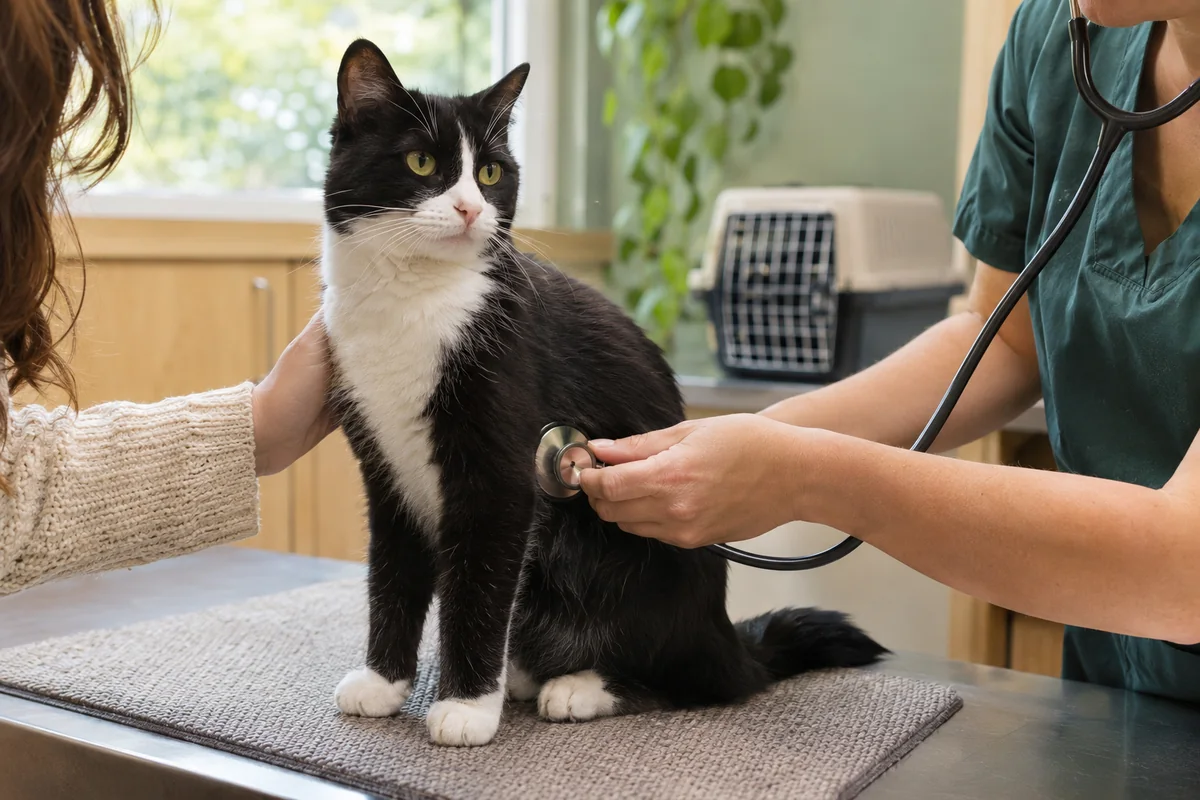
The sources don’t agree here either. Cornell says it isn’t unusual for a cat to bring up a hairball every week or two without lasting problems; VCA says to contact the vet if it vomits hairballs more than once a month; and MSD recommends consulting if it has hairballs or vomits repeatedly, and brushing it often to remove loose hair. With three different criteria, if they are frequent, mention it at the next visit.

What to do about food when a cat is vomiting
The sources don’t say the same thing, which is why it’s worth asking your clinic before touching the food:
- MSD: treatment of short-term vomiting generally requires withholding food for 24 hours; water should only be withheld if the vet gives fluids, because withholding it can worsen dehydration. If the vomiting stops, small amounts of water are offered and then food is gradually reintroduced.
- VCA: mild cases can be treated at home, and then the vet may indicate a prescription diet or a specific home-prepared one, bland and easy to digest, in small, frequent portions, with no other food during that period and with water always available.
- Cornell: a bland, easily digestible diet once the vomiting has stopped.
MSD warns of a risk: in an overweight cat, a process that causes anorexia or food deprivation can set the stage for hepatic lipidosis, the most common acquired and potentially fatal liver disease in cats. That’s why it’s worth asking first how long to wait and what to give.
If you have changed food recently
International Cat Care says that changing food gradually helps prevent vomiting and diarrhoea, and suggests offering the old and the new in separate bowls, with 75% of the old and 25% of the new at the start; some cats accept the change in 5-7 days and others take 2 to 8 weeks (International Cat Care).
There’s more detail in our guide to cat diarrhoea; if you’re considering cooked food, see our cooked food comparison.
What if it’s a dog?
For dogs the guidance is different: see our guide to why is my dog vomiting. Don’t apply to a cat what works for a dog without asking your clinic.
Frequently asked questions
Is occasional cat vomiting normal?
According to Cornell, even the healthiest cat vomits from time to time, but one that vomits more than once a week should be seen by a vet soon. For hairballs, Cornell speaks of one every week or two and VCA asks you to consult if there is more than one a month.
When should cat vomiting be seen by a vet?
It depends on the source: Cornell, if it vomits more than once a week or there are other signs; MSD, if it is more than once or twice a day, prolonged or with blood; VCA, straight away if there is blood, fever, lethargy, abdominal pain or diarrhoea, and if it continues for more than a day or two. If in doubt, call your clinic.
What can I give a vomiting cat?
The sources don’t agree: MSD describes withholding food for 24 hours in short-term vomiting, VCA speaks of a diet your vet indicates, bland and in small portions, with water available, and Cornell, of a bland diet once the vomiting has stopped. As lack of food has risks in cats (hepatic lipidosis, according to MSD), ask your vet first.
Why is my cat vomiting foam or yellow liquid?
On the MSD and VCA pages we read, neither colour nor foam is linked to a specific cause: their criteria are frequency, duration, blood and the other signs. If it happens once and your cat is well, it fits occasional vomiting; if it recurs or there are other signs, consult.
Can a cat vomit from a change of food?
It can: International Cat Care says changing food gradually helps prevent vomiting and diarrhoea, and suggests doing it with separate bowls and starting with 75% of the old food.
What shouldn’t I do if my cat vomits?
Don’t induce vomiting if you think it has eaten a toxic plant: International Cat Care says to contact the vet. Nor assume that something it has swallowed, such as a thread, will pass by itself: International Cat Care warns that often it doesn’t. In both cases, call your clinic as soon as possible.
This guide is informational and does not replace a consultation with your vet.
Keep reading
 Health & wellbeing
Dog constipation: causes and when to call the vet
A constipated dog strains and passes little or nothing. What the MSD manual, VCA, PDSA and AKC say about causes, food and water, and when to call the vet.
 Health & wellbeing
Cat diarrhoea: causes and when to see the vet
A cat's diarrhoea is usually brief, but sometimes it hides an illness. What International Cat Care, Cornell and MSD say about causes, food and when to call the vet.
 Health & wellbeing
Overweight dog: how to help it lose weight (2026)
If you can't feel your dog's ribs, it's carrying extra kilos. How to check, what to rule out with your vet and a plan so it loses weight at a safe rate.