How to train a puppy: a guide to the first weeks at home
Training a puppy isn't about "dominating" it: it's about making the most of a few very specific weeks of its development, with patience and positive reinforcement.
In this article
Training a puppy isn’t about “dominating” it: it’s about making the most of a few very specific weeks of its development, with patience, routine and positive reinforcement. What it learns — or doesn’t learn — in its first months shapes a lot of its adult personality, so it’s worth getting it right from day one.
The socialisation window: why the first weeks matter so much
Puppies go through a developmental period that’s especially sensitive to new experiences, roughly between 3 and 14-16 weeks old. During that window, they learn more easily what counts as “normal” and safe in their environment: people, other animals, sounds, surfaces, everyday situations. Once that stage has passed, it becomes considerably harder for them to generalise that sense of calm around the unfamiliar.
This doesn’t mean throwing them into everything at once or “toughening them up” by force: experiences need to be positive and controlled. A puppy that’s frightened by a situation that overwhelms it can end up learning exactly the opposite of what you intended.
Before anything else: basic house rules and routine
Before thinking about commands, it helps to get the basics clear first:
- Where it sleeps, and where it doesn’t. Decide which spaces are allowed from the start; it’s much easier than changing the rules later.
- A routine for meals and walks at roughly the same times each day: it helps your puppy know what to expect and reduces anxiety.
- A quiet space of its own (a bed, an open crate) that it can retreat to without being disturbed. It’s not a punishment: it’s a refuge.
- Consistency from everyone in the household. If some people allow something and others don’t, learning becomes much slower and more confusing for the puppy.
How to house-train your puppy
- Take it out very frequently: on waking up, after eating, after playing, and every 2-3 hours while it’s still very young.
- Always take it to the same spot so it associates the place with what it needs to do there.
- Reward it the moment it finishes, calmly and right then, not once you’re back inside.
- Don’t punish accidents. If you catch it in the act, interrupt it gently and take it outside; if you discover it afterwards, telling it off achieves nothing — it won’t connect the scolding with something it did minutes earlier, and it will only make it fearful or insecure.
- Watch for the signs: circling, sniffing the floor insistently or general restlessness usually mean it needs to go out.
First commands with positive reinforcement
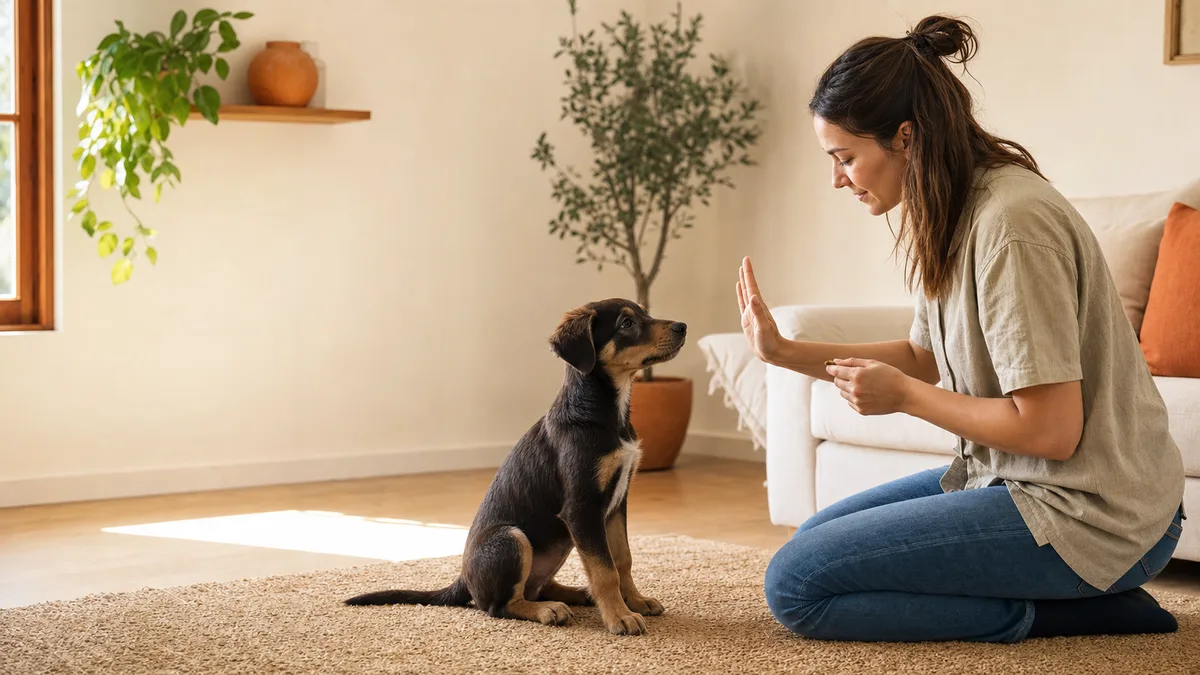
Positive reinforcement means rewarding — with food, your voice or play — whatever you want the puppy to repeat, instead of punishing what you don’t want it to do.
- Short sessions (5-10 minutes) several times a day: puppies tire and get distracted quickly.
- Recognising its name and “come”: the foundation for everything else. Reward it every time it responds, even if it’s just because it had nothing better to do.
- “Sit” and “stay” are good starting points: easy to shape by guiding a treat up and back over its head.
- Always end on a successful note, even a simple one, so the session gets associated with something positive.
Socialising properly (it’s not the same as exposing it to everything)
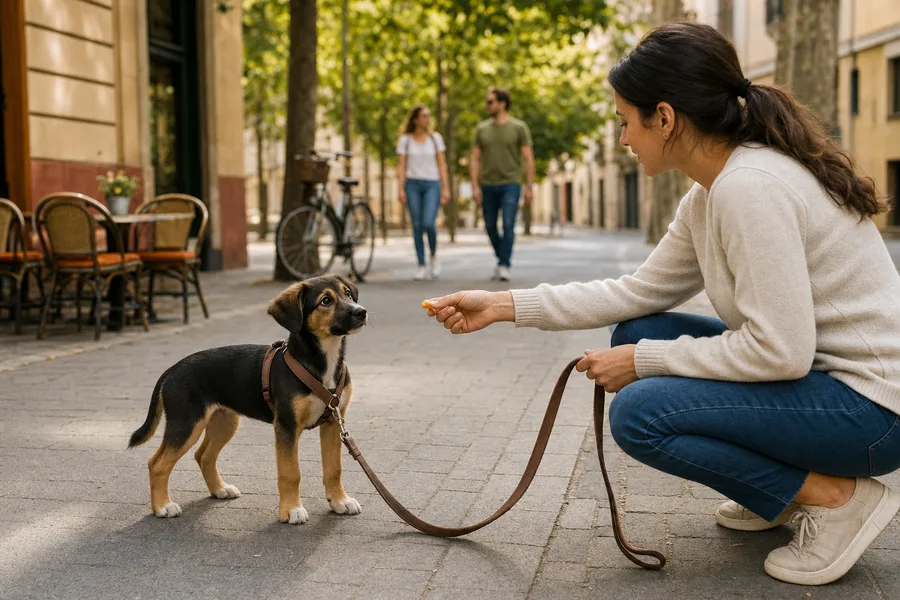
Socialising doesn’t mean meeting every dog in the park on day one: it means having positive experiences, at its own pace, with the things it’ll encounter for the rest of its life.
- Different people (different ages, clothing, hats, walking sticks), at its own pace, without forcing contact if it seems reluctant.
- Other dogs who are already vaccinated and known to be friendly, in short, controlled meetings.
- Everyday sounds (vacuum cleaner, traffic, doorbell) at low volume to begin with.
- Different surfaces and situations: getting into a car, stairs, slippery floors.
If it seems frightened at any point, don’t force it: move away from the trigger, give it time, and try again later from further away or at a lower intensity.
The “pack leader” myth
It’s common to hear that you need to “be the pack leader” or “dominate” a dog to get it to obey. This idea comes from old studies of wolves in captivity that didn’t reflect how wild packs actually behave, and that their own authors have since qualified. Current animal behaviour science doesn’t support methods based on imposing control or fear: besides being unnecessary, they can generate anxiety, distrust of their carer, or even defensive aggression. Positive reinforcement — rewarding what you want repeated — is more effective and doesn’t carry those side effects.
When to seek professional help
Most puppies come along well with patience and consistency, but it’s worth seeing a certified positive-reinforcement trainer (or a veterinary behaviourist) if:
- Signs of intense fear or aggression appear, towards people or other animals.
- You can’t make progress on the basics despite being consistent for several weeks.
- The puppy shows marked anxiety when left alone (beyond what’s expected during the first few nights).
Alongside training, don’t forget the vaccine, deworming and neutering schedule: health and behaviour go hand in hand during these early weeks. And if your puppy also barks excessively when left alone or in response to specific triggers, here’s how to correct it without punishment.
Frequently asked questions
At what age should you start training a puppy?
From the first day it arrives home, usually around 8 weeks old. The most sensitive socialisation window closes around 12-16 weeks, so the sooner positive experiences and basic house rules begin, the better. This doesn’t mean expecting adult-level obedience: at that age, it’s mostly about positive exposure and simple routines.
How long does it take to train a puppy?
The basics (house training, house rules, first commands) usually settle in after about 2-4 months of consistent work, but real training continues throughout the dog’s whole first stage of life. It isn’t a process with a fixed end date — every puppy has its own pace.
Is it true that you need to be the ‘pack leader’ to train a dog?
No. The idea of a dominance hierarchy based on imposing yourself by force comes from old studies of wolves in captivity that don’t hold up, and that their own authors have since qualified. Current animal behaviour science supports positive reinforcement (rewarding what you want repeated) over dominance-based methods, which can also generate fear or aggression.
How do I teach my puppy to go to the toilet outside?
Take it out very frequently (on waking, after eating, after playing) always to the same spot, and reward it as soon as it finishes there. Accidents indoors shouldn’t be punished: if you catch it in the act, calmly interrupt it and take it outside; if you find it afterwards, telling it off is pointless, since it won’t connect it with what it did.
When should I seek professional help to train my puppy?
If signs of intense fear or aggression appear, or if you can’t make progress on the basics despite being consistent, a certified positive-reinforcement trainer can help you course-correct early, before a bad habit sets in.
Keep reading
 Training & care
 My cat meows a lot at night: causes and what to do
Before blaming boredom, look at your cat's age: in an older cat, new night-time meowing can be a medical warning. Causes, a night plan and when to book a vet visit.
 Training & care
 Separation anxiety in dogs: what to do about it (2026)
Not everything that looks like separation anxiety is. Before assuming it, check the other causes that produce the same symptoms and what to do in each case.
 Training & care
 How much natural food your dog needs by weight (table by brand)
The neutral gram-by-weight table you can use with any brand, plus an honest rundown: who has a real calculator and who's just saying they do.